Cars For Sale - Used Cars For Sale - Used Cars - Sellcar-online.com®: Jetta

Cars For Sale - Used Cars For Sale - Used Cars - Sellcar-online.com®

Used Cars - New Cars - Search New & Used Cars For Sale

Showing posts with label Jetta. Show all posts

Wednesday, September 19, 2018

Modified Jetta breaks the speed record in its class in the USA with 338 km/h

September 19, 2018 0


  •  Jetta proves its potential on the legendary Bonneville Salt Flats in the USA
  •  The record-breaking Jetta is powered by a modified TSI engine with a power of 608 PS 
  •  After the success of the I.D. R Pikes Peak, Volkswagen has now set a third record within a very short time with the Jetta 


Wolfsburg (D) / Herndon (USA) – Volkswagen of America has demonstrated the potential of the new Jetta at the Bonneville Salt Flats in the USA. Here a specially equipped Jetta broke the previous world speed record of its class for land vehicles with 338 km/h. Only a few weeks after the success of the electrically powered I.D R Pikes Peak at the “Race To The Clouds” in the Rocky Mountains and at Goodwood Hill Climb in the UK, Volkswagen has secured its third record.

A four-cylinder turbo engine (TSI) from the EA888 series was responsible for the powerful propulsion of the new Jetta1. This engine is also used in other sporty Volkswagen models such as the Golf GTI Performance2 (180 kW / 245 PS). For the record-breaking rides, the power of the sports car engine was increased to 447 kW / 608 PS (at 8,500 rpm). Volkswagen engineers used new connecting rods, pistons, valves and camshafts as well as a larger turbocharger and a new exhaust system. The standard cylinder block and crankshaft remained unchanged.

The powerful TSI engine had an easy time with the new Jetta, as this Volkswagen is extremely aerodynamic. Thanks to a drag coefficient of 0.27, the Jetta raced with particularly low resistance through the dry air at Bonneville Salt Flats in the US state of Utah. It broke the previous record of 335.50 km/h (208.47 mph) with exactly 338.15 km/h (210.16 mph) in the BGC/G class of the Southern California Timing Association.

“The achievement of this speed in Bonneville proves the quality, durability, performance and efficiency of Volkswagen TSI engines and the aerodynamic performance of the new Jetta,” says Hinrich J. Woebcken, President and CEO of Volkswagen of America. Woebcken continues: “This record highlights the sporty qualities of our Jetta. It also provides a look into the future of the sedan, as we are using a modified version of the EA888 in the record-breaking car. This powerful TSI will also be used in the new Jetta GLI in the future.”

Achieving speeds of well over 300 km/h on the Salt Flats places special demands on the vehicle. The recording-breaking Jetta therefore features technical details such as a lowered chassis, special wheels and tyres for the Salt Flats, a limited slip differential for optimum traction and two brake parachutes at the rear. The interior was also completely cleared out. Only the controls for driving, a bucket seat with racing belts, a stable rollover cage and a fire extinguishing system remained.

The Jetta was built by Volkswagen of America together with the technicians of THR Manufacturing in Ventura, California (USA), who specialise in record-breaking driving of this type. The Salt Flats veteran Scott Goetz was at the wheel of the Volkswagen. “It was a great experience driving this car on the Salt Flats. Even at top speed, the Jetta provided a safe driving experience and I'm very happy we broke the record.”


Read More

Friday, June 22, 2018

Volkswagen Prepares All-New 2019 Jetta For Bonneville Speed Record Attempt

June 22, 2018 0


All-new Jetta is the basis for the Bonneville Jetta, which uses a 2.0-liter TSI® turbocharged four-cylinder engine for an assault on the BGC/G record at Bonneville Speed Week in August


Herndon, VA (June 22nd, 2018) – Volkswagen of America, Inc., announced today that it has prepared a specially-tuned 2019 Volkswagen Jetta to attempt the Southern California Timing Association’s BGC/G class record at the famed Bonneville Salt Flats in Wendover, Utah, over August 11-17, 2018. The Bonneville Jetta will be powered by a modified version of Volkswagen’s EA888 2.0-liter turbocharged and direct injection four-cylinder engine.

Built by Bonneville preparation specialists THR Manufacturing, based in Ventura, Calif., the Jetta previews the powertrain that will be used in the forthcoming Jetta GLI performance model. Volkswagen is hopeful that it can beat the existing class record of 208.472 mph, showcasing both the potential performance that the EA888 engine can achieve with modifications, and the all-new Jetta’s exceptionally aerodynamic shape, which yields a drag coefficient of just 0.27.

“We are delighted with the reception for the all-new 2019 Jetta in North America,” said Hinrich J. Woebcken, CEO of the North America Region, Volkswagen. “With the attempt on the Bonneville speed record with the Jetta, we want to underline the Jetta’s sporty credentials and get customers excited for the more performance-oriented Jetta GLI on the way.”

To run at high speed on the salt, the Bonneville Jetta has had many other changes from stock. The suspension has been lowered, special Salt Flat wheels and tires fitted, and a limited-slip differential added to aid traction. The interior has been stripped and outfitted with full safety equipment—such as a roll cage, racing seat and harness—and a fire suppression system. To help slow the car down, the Bonneville Jetta has been fitted with a pair of parachutes.

The Bonneville Jetta’s graphic treatment was the work of Volkswagen’s Southern California Design Center. “This was a truly fun project to be involved in,” said Reto Brun, Director, Volkswagen Design Center California. “We wanted to highlight the sporty nature of the Jetta and give the car design graphics that would make it really stand out on the alien-like environment of the Bonneville Salt Flats. We wish the team luck as they attempt to make this the fastest Jetta—and the fastest production-based Volkswagen—ever seen!”


Read More

Friday, May 18, 2018

Volkswagen Debuts 2018 Enthusiast Vehicle Fleet at SOWO: The European Experience in Savannah, Georgia

May 18, 2018 0


Herndon, VA (May 18, 2018) — With the summer enthusiast season just around the corner, Volkswagen of America, Inc. will unveil its enthusiast show concept fleet for 2018 at SOWO: The European Experience on Hutchinson Island, Savannah, Georgia, between May 17 and 20. Featuring five models from the brand lineup, these specially prepared show vehicles are inspired by the diverse design tastes of Volkswagen enthusiasts. Four of the concepts share a central fluorescent yellow theme to help them stand out. 


2018 Golf R Abstract concept

Using a unique camouflage print wrap, the Abstract concept highlights the recently released 2018 Golf R with DCC and Navigation. The car rides on 20-inch FR design wheels in Mystic Black from ABT Sportsline and uses an H&R Springs Sport Spring system that lowers the vehicle by an inch. ABT Sportsline also outfitted the Golf R with side skirts and an uprated stainless steel performance quad-exhaust system with matte black chrome 4-inch exhaust tips, which gives the powerful Golf R concept an even more dynamic sound. The steering wheel has been upgraded to a BAK Performance Mk 7 custom carbon fiber wheel complete with Golf R blue stitching. The camo design takes cues from the robust urban street art of the Wynwood Art District in Miami, FL, where the North American office of ABT Sportsline is located. 


2019 Jetta R-Line SoCal concept

In celebration of the launch of the seventh-generation Jetta, which lands in dealers this month, Volkswagen has been looking back on its predecessors for inspiration. The SoCal concept is a heritage-based design with modern accents. Taking inspiration from the Mk2 Jetta, the body graphics give a nod to the past while drawing attention to the strong vehicle design. Other visual highlights include fluorescent yellow mirror caps, a gloss black roof with geodesic fluorescent yellow design, and body-color wheels with yellow accents. SoCal-based wheel and automotive design company fifteen52 developed the overall concept, giving the car clean lines but with an aggressive stance.  KW automotive developed a prototype ST XTA Coil Over system with adjustable top mounts to lower the ride height 3 inches to properly showcase the fifteen52 Formula GT 19- x 8.5-inch wheels. Additional design elements will be added later in the season. 


2018 Tiguan R-Line Aero concept

The Volkswagen R-Line brand badging was the inspiration for the camouflage that wraps the Aero concept.  Air Lift Performance installed its 3P Air Management System with Performance Series front and rear struts, lowering the vehicle ride height up to 4.8 inches, giving this Tiguan concept the most aggressive attitude of the show fleet lineup.  Powder-coated, matte black Rotiform 20-inch Monoblock CCV wheels help balance the busy nature of the livery.  A Thule Motion XT Alpine rooftop carrier, wrapped with the same design scheme, rides on a Thule AeroBlade Edge roof rack system.


2019 Arteon R-Line Highlight concept

The 2019 Arteon lands in the United States later this year. The European enthusiast community has already recognized the potential of the sleek, coupe-like design and wide, planted stance to make a statement on the show field.  Vossen Wheels has clad the Arteon R-Line Highlight concept with its latest release, the Hybrid Forged HF-2, measuring 20 x 9.5 inches front and rear, while a prototype set of Ultra Low Coil Overs from H&R Springs drops the ride height by almost three inches. The Arteon concept has an ultra-fluorescent yellow wrap that accentuates its gloss black and chrome R-Line accents. 


2018 Atlas Tanner Foust SEMA concept

“Overlanding has risen in popularity in the past couple of years,” said Tanner Foust. “People are looking for ways to get outdoors and go on adventure trips with the whole family. The Atlas is perfect for off-pavement trips, and I wanted this concept to enhance the vehicle’s capabilities while still maintaining its utility and VW DNA.” 

Large tires and off-road wheels compliment the extended fenders and lower body panel cladding to give the vehicle an extreme off-road look. The bumper design raises the approach angle to help provide underbody protection. Light bars inset into the bumper and mounted on the roof illuminate the night for backcountry camping trips, while the roof rack with access ladder make sure there’s even more room inside for the whole family. Minimal changes to the interior include plaid inserts in the seats that are reminiscent of Volkswagen GTI heritage and also reflect on Tanner’s childhood in Scotland.
 
The Volkswagen enthusiast concept fleet will be making stops at events around the country. To catch a glimpse of these cars in person, be sure to visit one of the following enthusiast shows:
(Car appearances subject to vehicle availability)


Read More

Sunday, January 14, 2018

NAIAS 2018 - the all new Seventh Generation Volkswagen Jetta

January 14, 2018 0
 
The new Jetta - world premiere North American International Auto Show

17.5 million units of best-seller produced
World premiere of the new Jetta in Detroit, USA


Key facts: overview of the new Jetta1

  • Related to the Golf, Tiguan, Atlas and Arteon: that is because the car is, for the first time, based on the modular transverse matrix (MQB)
  • Benefits of the MQB: dynamic proportions, optimal space utilization and new range of assistance systems
  • Global best-seller: with 17.5 million units produced, the Jetta is one of the world's most successful Volkswagen cars
  • Into the starting gate: new Jetta will arrive in Mexico in the first quarter and will launch on the US market in the second quarter

Progressive design, interconnected systems

First Jetta based on the modular transverse matrix
MQB changes everything. Around 17.5 million Jetta cars have been produced, making it one of the most successful Volkswagen automobiles ever. Now the seventh generation of the best-selling car is making its debut. In a significant technical update, the 2018 Jetta is based on the modular transverse matrix (MQB) for the first time. The results: more dynamic proportions, a more progressive design, improved interior space, efficiency gains, assistance systems that are interconnected more than ever and—in the top versions—a largely digitalized interior.

German-American. In the U.S., the Jetta is the most successful automobile with German roots. From the East Coast to the West Coast of the United States, more than 3.2 million units have been sold to date. Therefore, it has been a long-running tradition that the world premiere of a new Jetta is celebrated in its main market, the USA. In 2010, it was presented in San Francisco, and in 2014 in New York. Now, in 2018, Volkswagen is revealing the latest generation of the Jetta at the North American International Auto Show (January 15–28) in Detroit, Michigan. The new Jetta was systematically designed to meet the needs of customers in overseas markets; there are no plans for a European version. A sibling model of the Jetta now being presented will be offered later in China under the name Sagitar.

Jetta features digital instruments for the first time. Making its debut in Michigan is the most advanced Jetta to date. In many trim versions of the new generation Jetta, standard features include assistance systems such as Front Assist (ambient monitoring system) and the Blind Spot Monitor (lane change system). In addition, Volkswagen is offering the Jetta as one of the first vehicles in its class to feature digital instruments (Active Info Display). Also new: an advanced generation of infotainment systems and a 400-watt sound system from the US audio specialist Beats by Dre. The Active Info Display and the infotainment systems are interconnected and configured in a completely new interior architecture with a digitalized surface that is arranged along a common visual and control axis.

Pioneering aerodynamics. The car's design is more dominant than ever. With its coupé-like styling, the body is more reminiscent of a sporty gran turismo such as the Arteon than a conventional sedan. In addition, it is also exceptionally aerodynamic with a Cd figure of 0.27; an improvement of around 10 percent in the car's drag coefficient optimizes efficiency. In turn, this has a positive effect on the fuel economy of the Jetta, which has a gasoline engine that is as fuel efficient as it is torque-strong: a 1.4 TSI that produces 110 kW / 150 PS and has a maximum torque of 250 Nm. As an alternative to the standard 6-speed manual transmission, it can now be ordered with an 8-speed automatic transmission. The new Jetta will launch in Mexico in the first quarter of this year and in the U.S. market in the second quarter.

Key aspects
 
Four decades of the Jetta
Seven generations of a global success

Jetta, Vento, Bora, Sagitar. 17.5 million Jetta cars have been produced since 1979. It is a global success that goes by many names. First presented in Europe as a car based on the Golf with a large trunk, the Jetta quickly became a success in North America and later in China. 2.3 million units of the first generation alone had been sold. Launched in 1984, the second generation would have sales of 2.7 million units worldwide.

The third Jetta was the Vento in Europe. In the U.S., meanwhile, the model series always kept its original name of Jetta. From 1992, 1.2 million units of this generation were produced.

The fourth generation Jetta followed in 1998, which was then called the Bora in Europe—with 4.6 million units built, it has been the most successful series to date.

In November 2004, Volkswagen introduced the fifth generation; the compact sedan reclaimed its name as the Jetta in Europe. At the same time, however, this generation launched as the Sagitar in China. Around three million car drivers worldwide purchased this four-door Volkswagen that was still a sibling of the Golf.

This changed in 2010 with the world premiere of the sixth Jetta, which was an entirely separate design from the Golf. This generation also wrote Volkswagen history, selling 3.7 million units. Over all of these years, by the way, around 3.2 million Jetta cars were sold in the United States. No other car with European DNA has been more successful from New York to Detroit, San Francisco and Miami.

Overview of the first six Jetta generations
  Jetta I Jetta II Jetta III Jetta IV Jetta V Jetta VI
Date of debut 1979 1984 1992 1998 2004 2010
Volume
(millions)
2.3 2.7 1.2 4.6 3.0 3.7


Part of a major Volkswagen product campaign in the USA
Two new models per year. The Jetta will continue to be one of the most important models in the USA for Volkswagen. After Volkswagen's "year of the SUV" in America in 2017—which saw the debut of the all-new Tiguan and Atlas—2018 will see the U.S. launches of two new sedans: the Jetta and Arteon. Going forward, there are plans to introduce two new Volkswagen models in the U.S. each year. By the end of this product campaign through 2020, the entire North American model line-up will have been updated, and the next generation of electric mobility will have launched. That is because after the I.D. in Europe, the production version of the I.D. CROZZ—the first I.D. model—will be introduced for the U.S. market.

Connected intelligencethe new Jetta
MQB as technology matrix. This is the first Jetta to be based on the modular transverse matrix (MQB). This means that the Volkswagen being revealed in Michigan is technically related to current MQB models such as the Golf, Arteon, Tiguan Allspace (all-new Tiguan for the U.S.) and the Atlas SUV that was developed for North America. All of these Volkswagen models have a high degree of digital connectivity and innovative assistance systems. Thanks to the MQB, the Jetta—which can be delivered in the S, SE, SEL and SEL Premium equipment lines in the United States—already has important assistance systems such as Front Assist with Autonomous Emergency Braking and the Blind Spot Monitor (warns of vehicles in the blind spot) as standard equipment from the Jetta SE trim version. Both systems are available as options for the Jetta S as well. An overview of all assistance systems offered in the Jetta for the U.S. market:
  • Adaptive Cruise Control (ACC)
  • Lane Assist (lane keeping system)
  • Front Assist with Autonomous Emergency Braking
  • Rear View Camera system
  • Rear Traffic Alert (system for backing out of parking spaces)
  • Blind Spot Monitor (lane change system)
  • Automatic Post-Collision Braking System (reduces risk of secondary collisions)
  • Light Assist (automatic activation/deactivation of high beam headlights)

Functional featurescoupling of ambient lighting and driver profile
LED headlights are standard equipment. A special atmosphere is created in the new Jetta by a large tilting and sliding panoramic sunroof (standard from Jetta SE) and an entirely new ambient lighting system that has been developed. This indirect interior lighting (standard from SEL) is an innovation in the immediate competitive field.

That is because a selection of ten different colors is being offered for the first time. In addition, the ambient lighting in the Jetta is also being coupled to the new driver profile selection. In the Normal profile, the light is white, in the Sport profile red and in the Eco profile blue. The driver can set any of the ten colors for the Individual mode. Light is also a dominant factor on the exterior.

Even the entry-level version—the Jetta S—comes equipped with powerful LED headlights. Volkswagen's use of LEDs as a standard feature for the entire model series is unique in this price class. Also implemented in LED technology are the daytime running lights and tail light clusters.

Proportions and aerodynamicsmore space, less air drag
More dynamic proportions. The new Jetta measures 4,702 mm in length (+43 mm), and its wheelbase has been lengthened by 35 mm to 2,686 mm. To put this into perspective: the dimensions of the Jetta that is offered in the USA approach those of the European Passat. Compared with the sixth generation Jetta, the front overhang was made shorter (-10 mm) and the rear overhang longer (+18 mm). This gives the new Jetta a sportier, more extended and more elegant look. The Volkswagen is 1,799 mm wide (+21 mm) and 1,459 mm tall (+6 mm). In keeping with its exterior dimensions, it offers more head and knee room as well as increased shoulder room and interior height. The long rear overhang also creates an impressive, large cargo capacity of 510 liters—a figure unchanged from the previous model.

Aerodynamic efficiency. The car's aerodynamics were also optimized by the new proportions and more precise design DNA. The drag coefficient (Cd) was reduced to 0.27—an improvement of around ten percent—by implementing a basic aerodynamic form with a special low-turbulence rear design,
flow-optimized underbody panels, drag-reduced aluminum-alloy wheels and an air curtain at the front end. (Vertical air intakes in the vicinity of the fog lights guide the air through the bumper and serve as an aerodynamic curtain in front of the wheelarches). The aerodynamic refinements have positive effects on fuel economy, CO2 emissions and wind noise.


Newly developed interiorpointing the way into the next decade
Interactive and connected. New in the Jetta are the digital instruments of the 10.2-inch Active Info Display (digital cockpit) that are individually configurable by the driver. These instruments are networked with the latest of the modular infotainment systems (MIB). Together they form a single digital display unit, both technically and visually. Always standard equipment: the Composition Color infotainment system, Bluetooth, USB audio interface and Volkswagen Car-NetÒ App-Connect. App-Connect is used to connect to smartphones and bring their apps such as Spotify Music into the car via MirrorLink, Apple CarPlayand Android Auto (Google). In addition, the Jetta (from the SEL trim) is the first North American Volkswagen to be available with a 400-watt sound system from U.S. audio specialist Beats by Dre.

Soft surfaces, precise lines. The brand new instrument panel design has an architecture that is largely defined by a future-based user interface philosophy. The most important aspect of this is that the instruments (digital from the Jetta SEL) and the new infotainment systems are arranged along a common visual and control axis. This results in a digitally networked,
gloss-black infotainment surface—a cockpit architecture which points the way into the next decade. All key display elements and controls also have a driver-oriented layout.


Two levels. The instrument panel itself is organized on two levels. The upper section with its sporty and ergonomic driver orientation integrates, as mentioned, all key functional units. Only the climate control interface is located as a separate module on the center console where it forms the upper termination of the console.

The lower part of the instrument panel has a strictly horizontal design with a fine decorative trim strip that runs beneath the cockpit, across the entire instrument panel and into the doors. Such details contribute to good utilization of space in the interior. One example: on the center console, there are not only two easily accessible cup holders, but also a plug-in socket for a tablet. In front of the gear shift knob—and beneath the user interface for climate control—there is also a storage compartment with a USB port for a smartphone.

Ergonomic seat system. The seat system was also completely redeveloped. The front seats have power adjustment in certain equipment lines. Available options, besides seat heating, include seat ventilation. The rear seat system has asymmetrically split and folding seats and a center armrest with cup holders.

Efficient and powerfulturbocharged gasoline engines
TSI and new 8-speed automatic. The Jetta engine is once again an efficient 1.4-liter TSI. The turbocharged, direct-injection gasoline engine develops an output of 110 kW / 150 PS at 5,000 rpm; its maximum torque of 250 Nm is available from 1,500 rpm. The base version, the Jetta S, is equipped with a 6-speed manual transmission. From the Jetta SE, a newly developed
8-speed automatic transmission transfers power to the front wheels (optional for the Jetta S). Its broader spread of gears has positive effects on drive-off performance and fuel economy.

 
Note:
Features and technical data of production models apply to models offered in the USA. They may differ in other countries.
All performance, fuel efficiency and emission figures mentioned in this press release are predicted figures, subject to official type approval, as of December 2017.


Read More

Wednesday, December 13, 2017

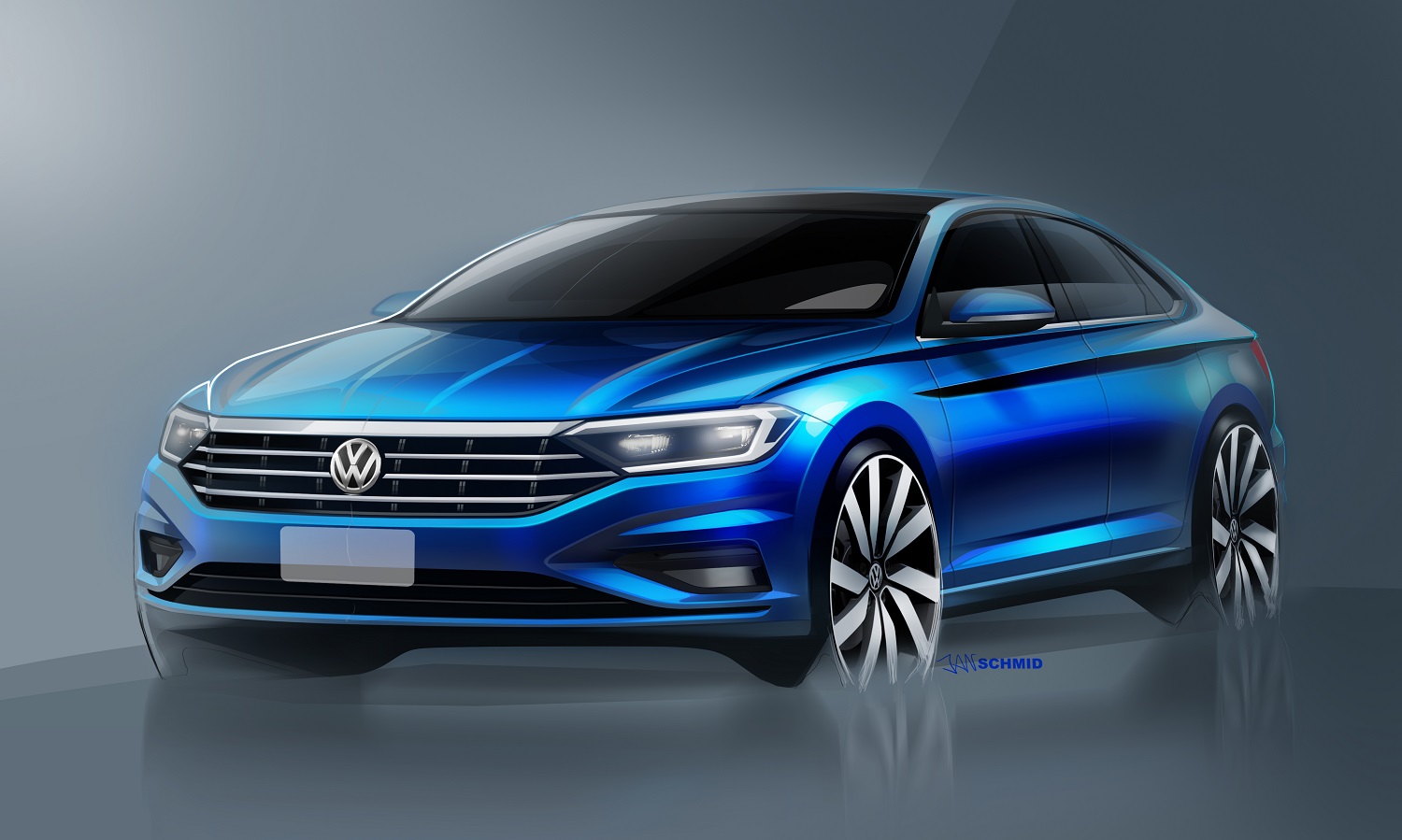
What we know about Jetta 7 as Design Sketches are Revealed

December 13, 2017 0


What we know about Jetta 7
  1. The Jetta is now based on the MQB matrix and will be built in Puebla, Mexico.
  2. RHD markets will not get Jetta 7 - UK, South African and Australian media have stated that they will not get Jetta 7 (Which we at Australian based VWNEWSBLOG are not happy about.)
  3. 1.4T 150hp engine will be the base engine mated to either 6 speed manual or 8 speed automatic gearboxes.
  4. Torsion beam based Rear Suspension is standard. Due to the budget being spent on MQB technologies instead. Expect like the Golf, versions with higher output to get the Multi Link Rear Suspension, like the Jetta GLI due in 2019.
  5. The interior is inspired by the all new MQB based Polo with the Volkswagen Digital Cockpit. The LCD instrument cluster and LCD radio navigation screen meld into a one piece mega screen but actually are two screens. The air vents are now under the LCD radio navigation screen instead of above like the Polo.
  6. Jan Schmid the Lead Exterior Designer of the Jetta 7 also designed the Golf R400 concept car.
  7. Front Assist. Side Assist, Blind Spot Detection, Active Cruise Control & Post Collision Braking etc are just some of the features on Jetta 7.
  8. The Fender sound system is deleted in favour of the beats audio system like the Polo and up!.
  9. Jetta 7 comes with 6 years bumper to bumper warranty.
  10. NAIAS 2018 is when the Jetta 7 will be revealed!


Read More

Tuesday, December 12, 2017

More Volkswagen MQB sedans on their way!

December 12, 2017 0


With the all new Jetta in the press, now is the time to reveal future sedans in the VW stable to come within the next 24 months.

Volkswagen is getting ready to add
to three more sedans to the MQB list that includes Passat, Lamando, Magotan, Virtus and the soon to be released 7th generation Jetta.
 
As seen below the pre-production prototypes testing the all new SAIC-VW Lavida and FAW-VW Bora now on MQB are due in 2019 after their SUV counterparts are revealed this year.

In fact according to a VW screen capture the hatch version of the SAIC-VW Lavida, the SAIC-VW Gran Lavida will enter production in 2018. Expect all the usual MQB goodies but torsion suspension for Chinese roads for the SAIC-VW Lavida and FAW-VW Bora .

The third sedan not pictured but of interest to both USA and Chinese readers. is The second generation NMS Passat now based on MQB and will built in Chattanooga, Tennessee and Anting, China by SAIC-Volkswagen will be in production by the end of 2018.

Exciting times ahead in the world of Volkswagen.
 
SAIC-Volkswagen (MQB) Lavida Testing


FAW-Volkswagen Bora (MQB) Testing


Sources
https://www.autohome.com.cn/news/201712/910557.html#pvareaid=102624
https://www.autohome.com.cn/news/201712/910720.html#pvareaid=102624
https://www.youtube.com/watch?v=ZI5mnt1J6v0


Read More