Cars For Sale - Used Cars For Sale - Used Cars - Sellcar-online.com®: FordTech

Cars For Sale - Used Cars For Sale - Used Cars - Sellcar-online.com®

Used Cars - New Cars - Search New & Used Cars For Sale

Showing posts with label FordTech. Show all posts

Monday, July 23, 2018

Could this tech spell the end of the phantom traffic jam?

July 23, 2018 0

You’ve waved good bye to work or school, packed your holiday bags, applied sunscreen, and now it’s time to hit the road… straight into stationary traffic.

In the UK and across Europe, huge numbers of drivers setting off on their summer hols make so-called phantom traffic jams a common occurrence.

These frustrating hold-ups appear seemingly out of nowhere on busy roads when one driver hits the brakes, causing a chain reaction as other drivers tap their brakes, eventually resulting in traffic behind grinding to a halt.

Ford has worked with a US university to show how an advanced version of cruise control already offered on 80 per cent of our vehicles can help reduce phantom jams by automatically slowing down and speeding up to keep pace with the car in front, without getting fatigued or distracted.

Adaptive Cruise Control tech uses radar to track the movements of traffic ahead. When Ford put it to the test on a closed track, it was able suppress the braking wave so the last car in the lane only slowed by 8 km/h (5 mph) instead of coming to a stand-still.

See the effects for yourself in this short film.


A new version of the system introduced in our new Focus can even keep the car centred in its lane and bring it to a complete halt in stop-start traffic, before automatically setting off again when the car ahead moves – helping further reduce the stress of driving in traffic.

Read More

Tuesday, July 3, 2018

Pothole detection in the new Focus irons out the bumps

July 03, 2018 0

Drivers are facing a “pothole crisis”’, made worse this year in some areas by the “Beast from the East” arctic air-mass, which delivered icy conditions that further contributed to shattered road surfaces.

A pothole was repaired every 21 seconds on average in England and Wales during the past year and harsh impacts can also cause damage that results in hefty repair bills for car owners.

Ford is helping limit the impact of damaged roads for drivers of the all-new Focus by introducing innovative pothole detection technology. The system senses when a wheel is falling into a pothole and adjusts the suspension so that the wheel doesn’t fall as far into it.

Because the tyre and wheel don’t drop as far, they don’t strike the opposite side of the pothole as harshly. The rear suspension can respond even faster than the front, with a signal from the front wheel providing a pre-warning to the rear wheel before it reaches the pothole. This all happens in a split second.

Guy Mathot, vehicle dynamics supervisor:
Our engineers are always searching for the roughest roads to really test our suspension to the limit, but more and more we're noticing that the rough roads are finding us. Potholes are a problem that isn’t going away anytime soon, but with our advanced suspension technology for all-new Focus, we've been able to reduce their impact.


The pothole detection system is a feature of the car’s optional Continuously Controlled Damping technology, which every 2 milliseconds monitors suspension, body, steering and braking inputs, and adjusts the vehicle’s suspension responses for the smoothest ride quality.

Ford develops suspension systems using a specially created road at the company's test facility in Belgium, which consists of precise replicas of some of the worst potholes and road hazards from around the world. Engineers further refine the systems with hundreds of hours of testing on a diverse range of European public roads, monitoring loads and strains with equipment similar to that used by seismologists to study earthquakes.

Read More

Thursday, June 21, 2018

Head-Up Display debuts in Ford's in the All-New Focus

June 21, 2018 0


Technology that was first developed for fighter jets is helping to improve the driving experience for the new Focus – that offers Ford's first Head-up display for Europe.

The display will make it easier for drivers to keep their eyes on the road as they monitor information including speed, navigation and road signs on a display that is projected to overlay the view ahead.

For some existing systems there can be a drawback – that for those wearing polarised sunglasses, which counteract glare, the display can be rendered almost invisible. Ford's Head-up display also emits the kind of light that polarised sunglasses are designed to eliminate from view. But a carefully tuned filter “bounces back” polarised light to the driver and effectively solves the problem.

Glen Goold, chief programme engineer for Focus
Wearing polarised glasses can make a massive difference to visibility for drivers affected by glare, such as when stretches of water, snow or even tarmac reflect sunlight. Our Head-up display also offers one of the brightest screens and has among the largest fields of view.

Summer evenings pose the problem of peak driving times coinciding with the sun being low on the horizon; in the UK the sun has been identified as the cause of almost twice as many accidents as snow, rain and fog put together. Head-up display ensures drivers will not need to glance down and refocus to see the information and notifications that they can select.

While traditional head-up displays utilise light waves vibrating parallel to the road, the Focus Head-up display boosts light waves vibrating perpendicular to the road, so the image can be clearly seen through polarised sunglasses. The polycarbonate screen has a multilayer reflection coating that enables engineers to control the polarisation, colour, transmission and reflection of light, and tailor it to the system’s needs.

The all-new Focus has been developed from the ground up to provide the most confidence-inspiring, intuitive, and rewarding driving and occupant experience of any mid-size family car in Europe. The widest range of advanced features and technologies on any of our vehicles enhances protection, driving and parking, and is designed to make the driving experience more comfortable, less demanding and safer.


Read More

Thursday, June 14, 2018

Bright idea! Smart jacket for cyclists

June 14, 2018 0

Finding the way through busy streets on two wheels can be daunting and for cyclists who take their eyes off the road to glance at navigation apps, this can also increase risk – both for them and for other road-users and pedestrians.

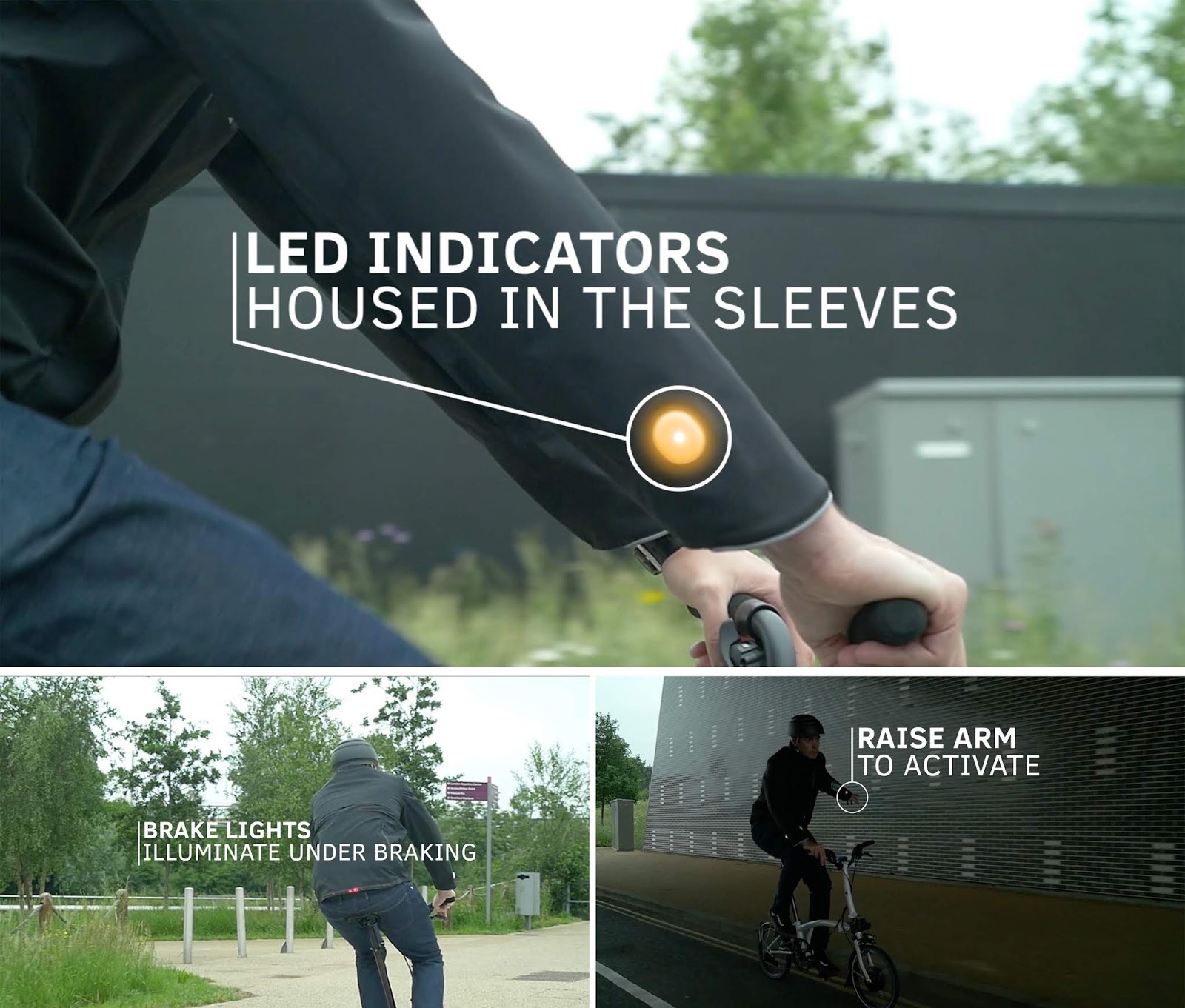
Now, some of our cycle-enthusiast employees have come up with a unique wearable that enables riders to find their way around more easily, and to more clearly display their presence and intentions to others, while connected to an app.

A post shared by Ford Europe (@fordeurope) on

Tom Thompson, from Ford's smart mobility team
We want to help people – and goods – move more safely, confidently and freely around our cities. The smart jacket concept helps us to better understand how the different players that a part of the urban mobility ecosystem are – cyclists, cars, and pedestrians – can better co-exist through the application of smart technologies and how we can apply those learnings to future ideas.

The smart jacket concept has sleeves that light up to show when wearers plan to turn right or left. Wirelessly connected to a smartphone, the jacket’s bike-friendly navigation app vibrates the appropriate sleeve, so riders know which way to go, using routes that avoid busy roads and junctions.


And there is no need for cyclists to take their eyes off the road or their hands off the handlebars to consult a smartphone screen. Audible and haptic interfaces enable riders to take calls, receive messages and repeat navigation guidance. The jacket also integrates a flashing brake light.


Thompson who helped to develop the jacket in his spare time.
There is an immediate change in mindset once there is no longer any need to stop to consult navigation apps directly on your phone – or worry if you’re heading into a particularly busy or dangerous road junction.

The cyclists who developed the jacket and have been trialling it on their daily cycle commute to their offices in London are charged with researching the “last-mile” challenge. This refers to the last-leg of a journey not only in the context of a personal commute but also around delivering goods and services in dense and congested urban environments. This leg is generally associated with higher cost and more complexity.


The smart jacket concept ties our “Share The Road” campaign that aims to foster greater harmony and empathy between both drivers and cyclists. It also coincides with a week when cycling and technology take centre stage through Bike Week UK and London Tech Week 2018.


Bicycles are becoming ever more popular in urban environments for commuting, for recreation and for delivering goods and services. During the morning peak, cycling is in fact the most popular mode of transport in the City of London, one of Greater London’s districts, where around three times as many people now ride compared with in 1999. *

Developed with urban cycling clothing specialists LUMO and mobility software experts Tome, the smart jacket concept underlines our collaborative approach to innovation. Further advanced features in the pipeline would enable commercial dispatch riders to access calls and messages using hand gestures and voice commands. The use of bone-conduction headphones avoids blocking out sounds from pedestrians and other road users, as earbud headphones might do – sending sound to the inner ear via vibrations to the jawbone.


For now, the smart jacket remains a prototype. However, we are in the process of securing the patent that it might in future be further developed or licenced to others, along with the companion app and know-how.


Read More

Tuesday, May 29, 2018

Hate reversing? A new Focus on what’s behind you

May 29, 2018 0

For several years now, reversing cameras that show drivers what is immediately behind them have become increasingly popular with new car customers.
Now, Ford Europe's new Focus is taking the technology a step further – by showing drivers what is around the corner behind them.
Located just above the licence plate, the camera captures a 180-degree view that can be displayed on a touchscreen inside the car – so passing pedestrians, cyclists and other vehicles can be more easily seen.


Reversing manoeuvres are also made easier by radar sensors that monitor the area behind the car and alert drivers to vehicles and motorcycles crossing behind. If the driver does not respond to warnings, the brakes are automatically applied.

Glen Goold, chief program engineer for Focus:
We know that for nearly all our customers, reversing is a crucial part of their daily drive – and one that some of them really don’t enjoy. This little camera is helping us to make a big step forwards in making it easier to go backwards. 


According to a recent survey, of the top five trickiest driving manoeuvres, four involved reversing, and the fifth was driving forwards into a parking bay. Ford Europe's new Focus also warns of vehicles and motorcycles that may soon be crossing behind. The car can automatically apply the brakes to avoid or mitigate the effects of collisions if drivers do not respond to warnings.


Read More

Friday, May 18, 2018

A peek inside Ford's new Environmental Test Centre

May 18, 2018 0

Ford’s new state-of-the-art Environmental Test Centre puts all the world’s weather under one roof, enabling engineers to test forthcoming vehicles in the most demanding conditions and make whatever weather they want at any time of the day.

Altitudes higher than Mont Blanc, the tallest Alpine peak, vehicle and wind speeds of up to 250 km/h (155 mph), and snow, glaring sunlight and rain are among conditions that are a push of a button away in Europe’s most advanced automotive environmental test centre. On an area the size of a football pitch, engineers can now take vehicles around the world, from the desert heat of the Sahara, to the arctic cold of Siberia and to the heavy humidity of Costa Rica

TROPICAL ZONE: THE HUMIDITY IS RISING

Humidity is a measurement of the water vapour in the air, and it can be blamed for that muggy, sauna-like feeling of some summer days. Humans are very sensitive to humidity, and vehicles can be too, which is why Ford vehicles undergo humidity testing in cold and hot conditions.


The wind tunnels in the test centre can take the humidity from 10 per cent up to 95 per cent. Engineers can make it rain heavily to see how quickly windows fog up and check wiper systems and visibility.

THE HEAT IS ON: EXTREME DESERT CONDITIONS

The temperature in the Sahara Desert can get close to 50° Celsius. Cologne is now hotter than that, getting up to 55° Celsius, just 1.7° Celsius lower than the highest-ever air temperature globally recorded. All Ford vehicles are tested in this extreme heat.


Two wind tunnels in Ford’s Environmental Test Centre feature 28 spotlights with 4,000watt bulbs. They simulate the powerful sun beams needed for testing that involves timing how fast the cabin can be cooled. Engineers can also push a vehicle to its limits: to check how extreme heat effects engine performance and see if the engine overheats at any point.

INTO THIN AIR: SCALING THE MOUNTAINS

The Mount Everest North Base Camp is at an altitude of 5,200 metres. The same altitude can be achieved in the test centre, which puts Cologne at a higher elevation than Mont Blanc, the highest Alpine peak. Ford vehicles are put through a range of tests to check the vehicle’s robustness and durability at different altitudes.


In the altitude lab, engineers can take a vehicle from 100 metres below sea level all the way up to 5,200 metres, and generate wind speeds of up to 120 km/h (75 mph) at that elevation. The high altitude cold start and durability tests ensure the vehicle’s liquids don’t burst their lines when working under higher pressure. Engineers can also combine altitude testing with hot and cold tests, cranking the temperature from -40° Celsius up to +55° Celsius.

DEEP FREEZE: CARS AS COLD AS ICE

The average winter temperature in eastern Siberia is -40° Celsius. That’s how cold it is in Cologne all year round, and all Ford vehicles experience this deep freeze to check the vehicle’s durability and robustness in the harshest winter conditions.


Ford’s Environmental Test Centre is the one place in Germany that’s guaranteed to have a white Christmas, and to have snow in July. In Arctic-like weather, engineers can see how fast a windscreen defrosts at different temperatures, check the effect of the cold on engine starts and see how long it takes to heat the cabin. Engineers can even make it snow from the ceiling, to check how the snow gathers on the vehicle’s roof and how much snow falls on the driver’s head when they open the door.


Read More

Monday, April 30, 2018

Feel The View - A smart window for blind passengers

April 30, 2018 0

From rolling hills to mountain ranges, views make any road trip memorable, but for blind passengers this is part of the experience that they miss.

A prototype smart car window aims to change this – by enabling blind or partially-sighted people to visualise passing scenery through touch.

Feel The View takes pictures that are turned into high-contrast monochrome images. These are then reproduced on the glass using special LEDs. By touching the image, different shades of grey vibrate with a range of 255 intensities, allowing passengers to touch the scene and rebuild in their mind the landscape in front of them.

Feel The View was conceived and developed by Ford's team in Italy and GTB Roma, in collaboration with Aedo – a local start-up that specialises in devices for the visually impaired.

Ford Italy spokesman Marco Alù Saffi
We seek to make people’s lives better and this was a fantastic opportunity to help blind passengers experience a great aspect of driving. The technology is advanced, but the concept is simple – and could turn mundane journeys into truly memorable ones."


Read More

Thursday, March 22, 2018

New tech helps find parking spots

March 22, 2018 0

The stress of searching for elusive empty bays in busy car parks may one day be a thing of the past, thanks to new technology being tested on the streets – and in the car parks of Milton Keynes.

Drivers can spend, on average, more than a day each year looking for vacant spots, according to a new study commissioned by +Ford Europe – and the new technology, being tested this week, displays a “crowd-sourced” map of available spaces, specifically in formal car parks.

Ford Europe expert Christian Ress.
We understand how much wasted time and unnecessary stress is caused by searching for parking spaces in towns and cities. With our research into ‘collaborative parking’, we see an opportunity to hand that time back to drivers, helping them enjoy happier, healthier and more efficient journeys.

+Ford Europe are among project partners to have developed “collaborative parking” and other vehicle-to-infrastructure technologies as part of the UK Autodrive project – a £20 million government-sponsored programme taking self-driving and connected-car technologies from the test track to the streets. With parking spaces in towns and cities across Europe increasingly difficult to find, it is hoped technology like this could help. **

“Collaborative parking” is powered by data from the parking sensors of vehicles using the car park. This informs the map that shows which spaces may be free – and can also incorporate data from the car parks’ own monitoring systems.


Read More

Wednesday, March 21, 2018

Brainy kids keep windscreen clean with reused rainwater

March 21, 2018 0

Ford have been testing how filtered rainwater could be used to keep windscreens clean – an idea that pre-teen siblings Daniel and Lara Krohn stumbled upon during a family road trip.

When the heavens opened, their dad Gerd, who was driving, tried to clear away the smears, but the reservoir was empty – and the windscreen just got dirtier and dirtier.

11-year-old Daniel.
It was a downpour. My sister and I thought that it was really funny that there was water everywhere – except for the windscreen wipers. Then the answer suddenly seemed obvious. Simply reuse the rainwater.

Together with his nine-year-old sister, Daniel tested the idea by taking apart their old toy fire engine, fixing the pump to a model car, putting it inside an aquarium and adding a filter. That was enough to win first prize in a local science competition in Germany – and for +Ford Europe  to develop the prototype for a full-sized test car.

Theo Geuecke, who worked on the project.
Daniel and Lara’s idea has been staring drivers in the face for decades – and it has taken one moment of ingenuity to bring it to life. In less than five minutes of rainfall the washer reservoir is completely full.

The system could one day help save billions of litres of water.

Nicci Russell, managing director, Waterwise.
What a brilliant idea! Innovations like these are essential to make the water we have go further. We will all need to change our behaviour to waste less water, but we’ll also need clever new bits of kit like the one Daniel and Lara have designed.


Read More

Friday, March 16, 2018

Tech for top athletes makes driving Mustang more fun

March 16, 2018 0

It’s what helps athletes with disabilities stay stable as they snowboard and ski. And now it is being used in the new Mustang for a better driving experience.

For amputees who have lost a leg above the knee, Magnetorheological fluid (MRF) enhances artificial knee joints so they better absorb impacts – and enables them to react more quickly following a high impact landing.

The use of MRF in Mustang’s MagneRide® suspension shock absorbers, or dampers, ensures the car is fun to drive and has a smooth, refined ride.


For those into technology, this is how it works: sensors monitor road conditions and electromagnets control iron particles suspended in oil within the shock absorbers.

The magnetic field is automatically adjusted 1,000 times per second to align the particles in individual dampers so they are firmer for sharp cornering, or softer for more comfortable cruising.

Joe Bakaj, our vice president, Product Development.
Athletes compete in extremely challenging conditions where control is everything. Similarly, with Mustang, MagneRide® helps drivers to react to changing conditions in real time by delivering exactly the right response for each situation.


More Ford Mustang stories, more Ford tech stories

Read More

Wednesday, February 28, 2018

Winter Driving - Staying Safe in Snow and Ice

February 28, 2018 0

If there’s one thing you can’t predict, it’s the weather, but +Ford Europe likes to prepare for any eventuality.

That’s why they tested all their range, including the Ford Mondeo in conditions including the worst possible ice and snow.

This video shows how Mondeo is equipped with the latest technologies to help keep drivers safe – and warm – behind the wheel.


No matter what you drive, when conditions turn icy, there is a lot YOU can do to reduce the chances of ending up in an accident.

Here's some excellent additional winter driving advice via the AA.

Batteries and electrics

Car batteries rarely last longer than five years, and there are extra demands on them in the winter, thanks to lights, heating and wipers.

Tips

  • Turn off electrical loads like lights, heated rear window and wipers before trying to start the engine.
  • Use the starter in short five-second bursts.
  • If the engine doesn't start quickly, wait 30 seconds between attempts.
  • If you don't use your car often, give it a regular overnight trickle charge.

Antifreeze

Antifreeze only costs a few pounds, but a frozen and cracked engine costs hundreds to repair. You need a 50-50 mix of antifreeze and water for the winter – this protects your engine down to -34C. Most modern cars use long-life antifreeze. Make sure you use the right type. Some types of antifreeze need changing after only two years. Check your service schedule.

Troubleshooting

A continuous squealing noise when you start up probably means the water pump’s frozen - it's the fan belt slipping on the pulley. Stop the engine straight away and let it thaw out. This could take days unless you can move it into a heated garage.

If your car overheats a few miles from home, it's likely that the radiator has frozen.  Stop straight away so you don’t cause more serious damage.

Vision

  • Clean your windscreen inside and out.
  • Keep the windscreen and other windows clear of dirt, snow and stickers, to avoid a fine.
  • Clear snow from the roof – it can fall onto the windscreen and block your view.
  • Air-con demists the screen faster and reduces condensation.
  • Replace worn or damaged wiper blades.
  • Don’t leave your wipers on auto when you park up if there’s a risk of frost. If the blades freeze to the screen, you could damage the blades or wiper motor when you turn the ignition on.
  • Use a suitable additive in your screenwash to reduce the chance of it freezing.

Here's some more advice on how to keep a clear windscreen during the winter months.

Visibility

  • Make sure all lights are working and lenses clean.
  • If the roads are really mucky you might have to clean your lights after every trip.
  • Keep number plates clean, to avoid fines.
  • If you have to clear snow, don’t forget the lights – front and back.
  • You must use headlights when visibility is seriously reduced. If you use fog lights, remember to switch them off when visibility improves so they don’t dazzle other drivers or obscure your brake lights.

Tyres

  • We recommend at least 3mm of tread for the winter.
  • Don't let air out of your tyres to get more grip – it doesn't work, and it’s unsafe.
  • Only use snow chains if there’s enough snow to prevent damage to the road.
  • Think about getting winter tyres or all-season tyres – these are made from a special rubber that gives better grip in cold, wet conditions.


Snow and ice

Take it slow – with stopping distances 10 times longer, gentle manoeuvres are the key to safe driving in ice and snow.
  • Wear comfortable, dry shoes for driving.
  • Pull away in second gear, easing your foot off the clutch gently to avoid wheel-spin.
  • Uphill – leave plenty of room or wait until it’s clear so you don’t have to stop part way up. Keep a constant speed and try to avoid having to change gear on the hill.
  • Downhill – slow down before the hill, use a low gear and try to avoid braking. Leave as much room as you can to the car in front.
  • If you have to use your brakes, apply them gently.
  • If you drive an Automatic, check the handbook – some have a winter mode or recommend selecting ‘2’ in slippery conditions.
  • If you do get stuck, straighten the steering and clear the snow from the wheels. Put a sack or old rug in front of the driving wheels to give the tyres some grip.

Before you set off

  • Allow extra time for winter journeys.
  • Try to get up at least 10 minutes early, to give you time to de-ice the car.
  • Check fuel levels – keep at least a quarter of a tank in case of unexpected delay.
  • Don't drive off like a tank-commander, with a tiny hole cleared in the windscreen.
  • Clear all windows using a scraper and de-icer.
  • Use a cigarette lighter to warm a key for a frozen lock.
  • Plan routes to favour major roads, which are more likely to be cleared and gritted.


More Ford tech or lifestyle stories

Read More

Monday, February 26, 2018

Waze joins Ford's SYNC3 system via AppLink

February 26, 2018 0

Drivers will soon be able to use navigation and traffic app Waze safely on the move with in-car connectivity system SYNC 3.

Waze is the world’s largest community-based navigation app (IOS / Android), and from April, customers will be able to project the app from the small screen on their mobile to the big screen in their car.

Ford’s Don Butler
We know that people enjoy a range of navigation apps to help them reach their destination safely and more efficiently, and have worked closely with partners to make this happen.

Announced today at Mobile World Congress, in Barcelona, Waze will join mobile navigation app Sygic on the AppLink platform, as well as the SYNC 3 Navigation System with FordPass Live Traffic.

Jens Baron from Waze
Waze works as a personal heads-up from 100 million of your friends on the road – and now that will include the many Ford drivers who will be able to safely access our app while on the move through the car display.

The mobile app from audio-on-demand and podcast company Acast (iOS / Android) is also coming to SYNC 3. Acast offers offline audio downloads plus an intelligent recommendation engine that analyses commute times to suggest podcasts that best fit journey length.

Further apps announced include:
  • BPme - iOS or Android  – finds BP petrol stations and pay for fuel from the comfort of your car
  • Radioplayer  - iOS or Android – from next month, discover and stream favourite radio shows, podcasts
  • Cisco WebExiOS or Android - safely join and participate in meetings on the go with voice commands

Read More

Tuesday, January 23, 2018

How to add a bit more of a buzz to your life

January 23, 2018 0

Forget romance, fine dining or an epic boxset – new preliminary research reveals that driving a sports car on a daily basis is among the best ways to boost wellbeing and fulfilment.

The study measured “buzz moments” – peak thrills that play a vital role in our overall wellness – as volunteers cheered on their favourite football team, watched a gripping Game of Thrones episode, enjoyed a passionate kiss with a loved one or took an intense salsa dancing class.

Only the occasional highs of riding a roller coaster ranked higher than the daily buzz of a commute in a sports car.

Working with neuroscientists and designers, we brought the research to life with the unique Ford Performance Buzz Car: a customised Focus RS incorporating wearable and artificial intelligence technology to animate the driver’s emotions in real time across the car’s exterior.

Dr Harry Witchel, Discipline Leader in Physiology
A roller coaster may be good for a quick thrill, but it’s not great for getting you to work every day. This study shows how driving a performance car does much more than get you from A to B – it could be a valuable part of your daily wellbeing routine.

Study participants who sat behind the wheel of a Ford Focus RS, Focus ST or Mustang experienced an average of 2.1 high-intensity buzz moments during a typical commute; this compared with an average of 3 buzz moments while riding on a roller coaster, 1.7 while on a shopping trip, 1.5 each while watching a Game of Thrones episode or a football match, and none at all while salsa dancing, fine dining or sharing a passionate kiss.

For the research, we took one Focus RS and worked with Designworks to create the Buzz Car:

From concept, design and installation to software development and programming, the Buzz Car took 1,400 man-hours to create. Each “buzz moment” experienced by the driver – analysed using a real-time “emotional AI” system developed by leading empathic technology firm Sensum – produces a dazzling animation across almost 200,000 LED lights integrated into the car.


The Buzz Car also features:
  • High-performance Zotac VR GO gaming PC
  • 110 x 500-lumen daylight-bright light strips
  • 82 display panels with 188,416 individually addressable LEDs


Driver state research

Our researchers in Aachen, Germany are already looking into how vehicles can better understand and respond to drivers’ emotions. As part of the EU-funded ADAS&ME project, our experts are investigating how in-car systems may one day be aware of our emotions – as well as levels of stress, distraction and fatigue – providing prompts and warnings, and could even take control of the car in emergency situations.

Dr Marcel Mathissen
We think driving should be an enjoyable, emotional experience. The driver-state research Ford and its partners are undertaking is helping to lead us towards safer roads and – importantly – healthier driving.

ActivityBuzz Moments *
Roller Coaster3
Driving2.1
Shopping1.7
Game of Thrones1.5
Football Game1.5
Kissing0
Salsa Dancing0
Dining0

* Average number of high-intensity buzz moments per participant


Read More

Thursday, January 4, 2018

How bee know-how is keeping valuables safe

January 04, 2018 0

The humble beehive has inspired our engineers to develop the “Honeycomb Shelf” – a lightweight, secret boot shelf with a strength-to-weight-ratio stronger than steel.

Developed for Ford's new EcoSport SUV and designed to conceal valuables that may be fragile, the adjustable shelf can support loads of more than 300 kg – heavier than three average adult men, even wearing full beekeeping kit – but weighing less than 3 kg.


Assistant chief engineer Bettina Veith
Nature is like one big innovation laboratory, and from bees to termites to beavers, animals are some of the world’s best engineers. The honeycomb’s ability to deliver strength without adding weight has already been put to good use in space rockets, jet planes and supercars.
To create the “Honeycomb Shelf”, engineers sandwiched a layer of honeycomb-like cells consisting of recycled paper and a water-based glue between two layers of light and durable fibreglass.  The lightweight solution also benefits fuel efficiency.


Read More

Thursday, December 7, 2017

Think like a racing driver – win at life

December 07, 2017 0

The secret to succeeding in high pressure situations might be found in the minds of racing drivers, according to Ford's latest investigation.


Using EEG (electroencephalography) headsets on a number of our professional drivers – including five-time FIA World Rally Championship winner Sébastien Ogier and three-time FIA World Touring Car Championship winner Andy Priaulx – we monitored the brain activity that deals with focus as they took on a racing simulator.

We then took some everyday drivers and did the same, which proved racing drivers minds were far more capable at dealing with the stresses involved.


However, with simple breathing and meditation exercises, plus a visualisation technique that uses keywords to describe the task ahead, the everyday drivers repeated the test… and improved their focus and performance by as much as 50 per cent, almost on a par with the pros.

Based on the research, we’re now developing an EEG-equipped racing helmet for our pro drivers, where brain activity data can be transmitted back to the team during a race alongside other in-car car telemetry. Understanding a driver’s mental state might just be the next frontier in performance.


So next time you’re faced with a tough interview or an important presentation, just get into the mindset of a racing driver and you’ll be winning at life.


Read More

Wednesday, November 15, 2017

Ideas in cancer treatments & car making coming together

November 15, 2017 0

After being diagnosed with cancer, quality director at the Ford assembly plant in Cologne Germany, was fascinated by the process through which patients were treated and an opportunity to introduce practices from the car manufacturing facility so that it might run more smoothly.


Working together with his colleagues, at the assembly plant the team researched and proposed changes that are now being implemented as part of what is expected to become Europe’s biggest dedicated cancer unit.

The team in the auto plant and staff at the renowned Centre for Integrated Oncology (CIO) at the University of Cologne have since developed a two-way flow of ideas, the medical team are bringing their experience of working with big data to bear on Ford research into future vehicles.

Mike Butler: quality director at Ford
I spent five years in treatment rooms and thought about how I could make life easier for patients. There was a real lightbulb moment when I realised that many of the systems that ensure car plants run smoothly could be applied to the hospital. Now there is an ideas exchange that is benefitting patients today, and could also help the way we move tomorrow. The more we work together the more synergies we find between our work at Ford and the challenges faced in cancer research.


It was back in 2008 that medical staff were first shown the advanced technologies and efficient processes that have enabled the Ford Fiesta Cologne plant to become one of the world’s most efficient vehicle production plants. A team of 10 to 15 Ford engineers met with hospital administrators as well as patients, nurses, doctors, and the collaboration blossomed from there.


Designed to ensure treatment is less stressful and faster, coloured lines on walls and floors make it easier for staff, patients and visitors to find their way around; and large screens will help make communication between key medical employees easier. The team also proposed flexible rooms with removable dividers rather than rigid wards and fixed nursing stations. At the existing facility, all of this has already contributed to a 30 per cent improvement in patient flow.


Meanwhile, the medical teams at the hospital are advising Ford on the processes they use to conceive and develop completely different approaches to tackling cancer. The company is now applying this “outside the box” thinking in relation to future vehicles and new technologies.

Prof Dr Michael Hallek, the director of the CIO
Medicine is an ever-changing science where small changes have a huge impact on the lives of patients. With Ford’s help, we are making huge improvements that will benefit the lives and treatment of future patients for years to come. And hopefully, some of our methods of doing things will help Ford to develop what mobility might look like in the future.


Read More

Tuesday, October 31, 2017

"Robo Butt" - The Robot which mimics a human bottom

October 31, 2017 0

A robot has been created to move like a human behind – and perfectly simulate how drivers and passengers get in and out of their car seats.

Engineers used pressure maps to establish a “perch pattern”, the data enabling them to test the wear and tear of materials, using the robotic bottom – or “Robutt” – to mimic the most common paths.

Durability engineer Svenja Fröhlich
From the first moment we get into a car, the seat creates an impression of comfort and quality. Previously, we used pneumatic cylinders that simply moved up and down. With the ‘Robutt’, we are now able to replicate very accurately how people really behave.


Based on an average-sized large man, the “Robutt” was used to simulate ten years of driving in just three weeks as part of testing for the new Fiesta – sitting down and getting up 25,000 times. The new test is now being rolled out for all our vehicles in Europe.


Read More

Thursday, October 5, 2017

Stop your Mustang being an alarm clock for the neighbours

October 05, 2017 0

For some, there is no better sound to start the day than the firing up of a finely tuned sports car engine. For others, it can lead to a call to the police and a request to keep the noise down.

This was the scenario which led Steve von Foerster’s to come up with a “Good Neighbour Mode” that will enable new Mustang drivers to schedule a full-throated roar just for when they won’t bother anyone, or to tone it down a bit to ensure they stay on friendly terms with nearby families.

Steve von Foerster - Ford user experience team lead in product development in the U.S.
I love the sound of the V8 engine, but it can be loud, and you can’t annoy people like that in your neighbourhood. I thought, ‘There has to be a way to give people more control over the engine’s sound.’
According to a recent poll by Ranker.com, loud engine revving ranks among the most annoying noises neighbours make, alongside other common nuisances including power tools, barking dogs and band practice. Only early-morning lawn mowing is more despised.

Some sports cars already offer active exhaust systems that can be turned on and off, Mustang’s “Good Neighbour Mode”, or Quiet Start, is the first to allow times to be scheduled. Drivers toggle through a menu in the instrument cluster to select the sound they want. For example, between 8 p.m. and 7 a.m., drivers can keep the peace by scheduling their car to start, minus the roar.

Both new Quiet Exhaust mode and Quiet Start features will be part of the available active valve performance exhaust system on the new Ford Mustang, which automatically adjusts the decibel level of the exhaust note according to the different drive modes, from Normal and Sports up to Track mode that emits a satisfying 82 decibel growl.

Matt Flis, Ford exhaust development engineer.
Sounds upwards of 80 decibels can start to irritate people; some of the most annoying sounds imaginable, such as a coffee grinder, or lawnmower, have decibel levels in the high eighties. With Quiet Start activated the decibel level of the new Mustang GT drops by about 10 decibels, to a much more comfortable 72 decibels.


Read More

Thursday, September 21, 2017

Ford is expanding testing Microsoft's HoloLens globally

September 21, 2017 0

Ford designers have been swapping some clay-sculpting steels and rakes for mixed reality headsets and visualization software that can change vehicle design elements – side mirrors, grilles, vehicle interiors and more – in mere seconds.

Designers have been piloting Microsoft HoloLens technology for a year now in Ford’s Dearborn studios, allowing them to see proposed virtual design elements as if these pieces were part of physical vehicles. They’ve been able to explore different shapes, sizes and textures of future vehicle attributes in minutes and hours instead of the weeks and months it can take to create clay models. And now, Ford is expanding this pioneering testing across the globe.

Jim Holland, Ford vice president, vehicle component and systems engineering.
It’s amazing we can combine the old and the new – clay models and holograms – in a way that both saves time and allows designers to experiment and iterate quickly to dream up even more stylish, clever vehicles. Microsoft HoloLens is a powerful tool for designers as we continue to reimagine vehicles and mobility experiences in fast-changing times.

HoloLens technology uses mixed reality, which enables designers to see holograms in photo-quality backdrops through wire-free headsets. They can scroll and preview at the flick of a finger through numerous design variations projected virtually onto an actual car or clay model.

Craig Wetzel, Ford manager, design technical operations.
We may not be able to teleport yet, but HoloLens allows us to review full-size 3D designs with designers and engineers around the world in real time. And we’ve only just scratched the surface, so possibilities for the future seem almost limitless. This is very exciting.

Seeing the future

As designers wearing headsets move around an actual vehicle, the Microsoft HoloLens scans and maps the environment far more accurately than GPS to render holograms and images from the angle at which the vehicle is being viewed. A Windows 10 computer embedded in the headsets brings the power of the operating system to a holographic device that is untethered, wearable and mobile. Traditionally, designers and engineers have to wear headsets that rely on cables tethered to a PC.

Designers see 3D holographic images of themes and features as though these elements were already part of the vehicle – allowing them to quickly evaluate the design, make changes, and determine styling options earlier in development.

Michael Smith, Ford design manager.
With HoloLens, we can instantly flip through virtual representations to decide which direction they should go. As a designer, you want to show, not just tell. This is much more compelling.

Ford has adapted HoloLens technology to enable designers to collaborate with engineers to better understand the customer experience, too. For example, the technology allows a designer and engineer to evaluate in near-real time how a new side mirror looks aesthetically, as well as the customer’s view of the vehicle’s surroundings.


Whereas today it can take days, even weeks, to study a grille design, HoloLens allows designers and engineers to explore a variety of different iterations in a matter of hours. The headsets can even be synced to allow multiple team members to view a design simultaneously, making collaboration easy. They can also record audio notes – high-tech “sticky notes” – for team members working in other time zones or off-site.

Beyond the global design test, Ford is investigating how to bring HoloLens technology into more engineering development processes to further bolster the company’s lead in using advanced visualization technologies such as virtual reality.

Elizabeth Baron, Ford virtual reality and advanced visualization technical specialist.
HoloLens allows a whole team of people to collaborate, share and experience ideas together. Mixing virtual and physical models is exciting, because it helps our designers and engineers communicate effectively and ideate to see what the future looks like earlier in the process. This allows great freedom and efficiency in how prototypes are created or changed.


Read More