Cars For Sale - Used Cars For Sale - Used Cars - Sellcar-online.com®: Computer Graphics

Cars For Sale - Used Cars For Sale - Used Cars - Sellcar-online.com®

Used Cars - New Cars - Search New & Used Cars For Sale

Showing posts with label Computer Graphics. Show all posts

Thursday, February 13, 2014

Fractal-Powered CGl Film

February 13, 2014 0


This video of morphing and turning space rocks was created not by sculpting or modeling in the usual way, but rather by using fractal mathematics. (Video link).

One of the principles of fractal geometry is self-similarity, where large forms are composed of smaller and smaller components that share the same geometry. This is a design principle found in nature in rock forms, cloud shapes and branching forms. Fractal powered digital graphics provide a a tool for building worlds for animation and computer games.

The video was by Julius Horsthuis, rendered in Mandelbulb 3D, with music by Maurice Horsthuis.
Read More

Wednesday, February 12, 2014

CGI eye simulation

February 12, 2014 0

Here's a remarkably believable computer rendering of a human eye by Chris Jones, using Lightwave, Sculptris and a little Krita. He wrote the music, too. 
----
Read More

Monday, February 3, 2014

Are we out of the Uncanny Valley?

February 03, 2014 0


Popular Science put together this video summary of the phenomenon of the uncanny valley in robotics, computer animation, and games. (Link to video)

The term "uncanny valley" was coined by Japanese roboticist Masahiro Mori in 1970. It refers to how artificial characters become more and more attractive as they become more realistic—up to a certain point, when they become creepy and repellant.

Another example is the rampaging baby in Pixar's early experiment "Tin Toy." (Video link)

Scientific American article suggests some explanations for why these failed lookalikes put us on edge. The phenomenon might be related to the unconscious switchover that happens when we believe something to be truly human. Our rising empathy in what we believe to be human can be betrayed by a simple failure of eye contact or head movement, invoking our concern or disgust at seeing a fellow human who is ill.


A related dreadful feeling happens when we see a Madame Tussaud waxwork, only to discover that it is real. This video shows such a prank as fan girls pose with what they think is their favorite boy band. (video link).

Masahiro Mori's paradigm suggests that there's a way out of the valley on the far end, as we approach very accurate simulation. Are we there yet? Have you seen anything recently in the realm of robotics or CGI simulation that you feel is truly appealing? If so, please let me know in the comments.

Previously on GurneyJourney:
Activision reveals real-time face simulation
Bert Untooned
Read More

Wednesday, December 11, 2013

Waterlogue App

December 11, 2013 0
Tomorrow a fun new app for the iPhone and iPad will be released called Waterlogue. The app interprets a photo to look like it was painted in watercolor.


The developers let me play with an advance version of it. I started by taking a photo of our teapot using our iPad. Then Waterlogue started dissecting the image in real time, searching out contours, dropping in blotches of color, and applying watercolor-like effects, such as a wet-into-wet color bloom. Like magic, and it's accurate with ellipses!


It goes beyond typical Photoshop watercolor filters because it has more visual intelligence, and more of the feel of the real paint. But of course you can still sense the photo behind it.


Here's one based on a photo of me sketching on the streets in Shanghai. The app gives you several different painting styles to choose from. My favorites were Natural, Luminous, and this one, Travelogue. Like a sketch, it leaves unpainted lines at the top, and little white dots in the darks.

The app was designed by John Balestrieri and Robert Clair, who are readers and commentators on this blog. Of course it's no threat to traditional artists (unless the art that someone does is little more than an app), and no substitute for actual sketching. To my mind, it's just a fun new way to think about image-making.

You can pick up a copy of the app when it's released tomorrow, or sign up today for a reminder at the Waterlogue website.
Read More

Thursday, December 5, 2013

Fluid dynamics effects reel

December 05, 2013 0

Artists in the digital realm continue to create fresh visual wonders. Here's a fluid effects reel by Jesse Pitela that shows off some amazing splash and flow dynamics.

I'm not sure exactly how this stuff works, but I'm guessing it involves some sophisticated simulations involving momentum, air resistance, surface tension, and gravitation. Plus a wonderful artistic sense of timing, lighting, and composition. (Link to video) Thanks, CG Bros.
Read More

Tuesday, September 17, 2013

Postvisualization

September 17, 2013 0

In big-budget live action movies, an increasingly important part of the CGI pipeline is a step called "postvisualization," which means a series of shots with low-res digital effects created after principle photography.

(Direct link to video) This documentary explains the advantages that postvis gives the director and editor to allow them to make good storytelling decisions and bid the effects accurately before the expensive rendering of the final shots.
----
Via CGBros
Read More

Monday, September 16, 2013

Aaron Becker's "Journey"

September 16, 2013 0

Blog reader Aaron Becker created the bestselling picture book 
He told me that he builds digital maquettes before doing his finished illustrations in traditional watercolors.

I invited him to do a guest post explaining the process, so here it is:

"Journey began as this large scale drawing, completed over the course of two afternoons three summers ago."

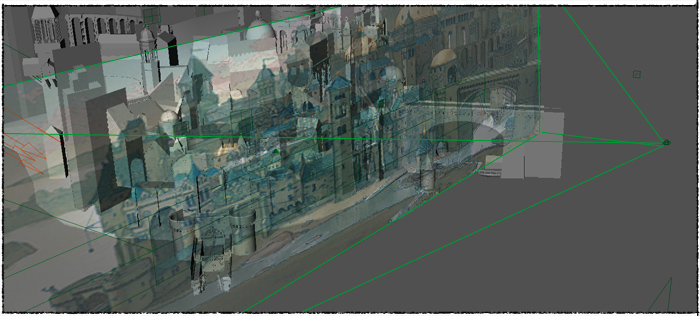
"Once the story had been roughed out, I returned to the original drawing and built this 3D model in Maya as a proof of concept – to see if I could replicate the spirit of the drawing as a detailed digital model. I would use this to help with perspective and lighting, and went on to build similar models for other environments in the book."

"At this stage, I’ve added significant detail to the 3D model with a new scanned pencil drawing. This light overlay gets printed out onto 300 LB Arches watercolor paper using my Epson large format printer."

"This allows me to dive into the watercolors with the confidence that my composition and perspective is spot-on. I prefer the heavy stock for watercolor as it minimizes warping and allows for fantastic control over the amount of moisture while applying pigment."

"From there, it’s a matter of old-school pen and ink and watercolor. I do the pen and ink first, making sure to give myself the freedom to change anything from the pencil underlay should the spirit move me. That said, I find the more I’ve decided conceptually ahead of time, the more I can concentrate on pure technique at any stage of the image-making game."

"Watercolor is applied in several washes from light to dark and then finished up with shadow details. I try to minimize the use of any masking fluid as I find this changes the quality of the paper for subsequent washes. Gouache was used for all of the punchy red and purple bits throughout the story."
"When it came time to create the book’s video trailer (see below), I went back into the 3D model and camera-mapped the watercolor painting onto the geometry, like a virtual slide projector covering a foam-core model. After separating the painting into several layers (background, towers, castle walls, etc) I was able to move a virtual camera in Maya and bring the image to life."


"Some details, like the waving flags were hand animated and projected onto transparent “cards” in Maya. This entire technique is similar to how matte paintings are now done in feature films. Having come from a film background, I wanted to utilize as much of the tricks I had learned as possible, while retaining the hand-made feel of the watercolor paintings. In the end, there are no shortcuts when it comes to dipping a brush into pigment and placing it on the page. Hope you all enjoy the finished product!"

JOURNEY by Aaron Becker (official trailer) from Aaron Becker on Vimeo.

Here's the book trailer Aaron created.

Find out more about Aaron Becker's work at http://www.storybreathing.com or on facebook.

Be sure to read the comments on this post, which explain a variety of inexpensive software options, such as Sketchup and Blender.
-----
You can pick up the book online at:
or Barnes and Noble
Or you can order a signed copy from Aaron's local independent bookseller, Odyssey Books.
Thanks, Aaron!
Read More

Thursday, September 12, 2013

Extracting a 3D model from a 2D photo

September 12, 2013 0


In this remarkable demonstration, Daniel Cohen-Or and colleagues demonstrate a method of digitally inferring a three-dimensional solid from a 2D photo. (Direct link to video). This could be a big timesaver for digital modelers and matte painters.
--------
Thanks, Rob Nonstop
Read More

Wednesday, September 4, 2013

Digital animation by Matthias Müller

Saturday, August 24, 2013

Logo Animation from Mud and Cardboard

August 24, 2013 0

If you ever need to animate your logo for video, you have two choices: spend thousands of dollars on a high-tech digital motion graphics that will look fake and dated in five years, or make it yourself for next to nothing out of cardboard, wire, and mud. (Direct link to video)


Here's me and Jeanette behind the scenes during filming.

With a lot of filmmakers looking for practical, in-camera effects, this is the best way to get logo animations grounded in reality.

This analog technique is also a good way for artists using CGI to quickly and cheaply generate reference of real effects little nuances of wind vortices in smoke, cast shadows, etc, which would be hard to imagine in purely digital simulations.

What I plan to do with this re-usable frame is to shoot it in a few different environments, such as in front of a roaring bonfire or in the middle of a fern garden.


Here are some of the real animated logos for inspiration (link to video).

Other news
For those of you following the "How I Paint Dinosaurs" video— we've now got the digital download also at Sellfy that accepts Paypal. You can access it directly at this link. It's also available via credit card at Gumroad and as a DVD at Kunaki

Read More

Friday, July 26, 2013

Google's research on machine perception

July 26, 2013 0
Google is making huge strides in artificial (or machine) vision. Until now, most machine vision systems have been used on robotic assembly lines and other highly controlled environments.


One of Google's goals is to bring machine vision into the real world and see how well it does recognizing objects. Above are images of both specific and general objects gathered into sets based on features that the computer is trained to look for. Extracting these features from a digital image—or from a live video capture— can be immensely complex and subjective, especially when an object is seen in various angles and lightings.

As it improves, machine perception will help with driverless cars, so that the car can read street signs, look for garage sales, or distinguish black ice from a wet street. It will also be valuable for Google Street View to be able to know what it's looking at, and Google Glass to aid users in recognizing things at superhuman levels of ability: for example, to know the make, model and year of every car in your visual field.

It won't be long before machine vision surpasses ours in certain respects, and it already does so in many ways. One recent study demonstrated a machine system that could extract 100,000 features from a scene, while a comparable human could extract only 10,000. Part of the computer's advantage comes from GPS location-based information that gives it context to make such observations.


To make progress in this field, Google has been supporting scientific research in visual perception, and hosting experts in the field to give lectures, which you can watch online. This one (video link), by Dennis Proffitt brings out the point that non-human creatures definitely don't see the way we humans see. The frog, for example, is predisposed to see moving edges, moving dots (read insects), and changes in illumination.

Later in the talk (at 20:00) Proffitt describes a study that demonstrates that a right-handed person perceives their right arm to be longer than their left arm, and at 36:00, he shows that a person's estimate of walking distance to visible objects is directly correlated to their physiological health. At around 48:00, he suggests that our perceptual systems compresses vertical dimensions depending on the size and position of the screen or canvas.
----
A list of Google's online resources about machine perception
Read More

Monday, July 22, 2013

Video with "graphic novel" look

July 22, 2013 0
Is it possible for a computer to process a video so that it looks like a comic book?

Friday Lunch from Tinrocket, LLC on Vimeo.
This video by Tinrocket (Direct link to video) demonstrates a beta version of a "graphic novel filter" that can be applied to video images. The software has a few tricks that go beyond a normal Photoshop filter, and those tricks are part of a patent application that's currently in the works.

The magnified visual "noise," the low frame rate, and the stark simplicity of the black and white imparts an artistic effect. This happens not only because the images superficially remind us of the appearance of human-created drawings, but because the computer software simulates some of the organic processes of human visual perception.

In the coming years, with advances in computer processing and progress in our understanding of human vision, we will see additional automated filter apps that can alter timing, proportion, color, and detail so that video footage can be morphed into various artistic altered realities.

Thanks, John Balestrieri
Read More

Saturday, June 8, 2013

Siggraph highlight reel of CGI innovations

June 08, 2013 0

Siggraph is the forum for sharing innovations in computer graphics and interactive techniques. This highlight reel shows some of the recent breakthroughs. It sort of makes visual sense even if you don't understand all the technical jargon.

Thousands of professionals in the industry will be converging on Anaheim, California this July for Siggraph's 40th international conference. (Direct link to YouTube video)
Read More

Saturday, May 4, 2013

IllumiRoom extends the game screen to the whole wall.

May 04, 2013 0

(Video link) IllumiRoom is a home entertainment projection device that extends the action of a game beyond the screen and onto your living room wall. It even scans and learns the furniture in the room and distorts it to enhance the game.
Read More

Sunday, February 24, 2013

WPI Game Development

February 24, 2013 0
On Thursday I visited the Worcester Polytechnic Institute (WPI) in Massachusetts as a guest of the department of Interactive Media and Game Development (IMGD), where I gave a  lecture on Worldbuilding.

The IMGD program at WPI is designed to provide students with both programming expertise and art knowledge so that they're well rounded in their approach to interactive design.

One of the professors is Britt Snyder (left, with a Jordu Schell sculpt between us). Britt has worked as an artist in the field of video game development for the past 13 years, with clients like SONY, Blizzard, Liquid Entertainment, Rockstar, THQ, and many others.
He teaches 3D modeling, digital painting, and concept art.

WPI was one of the first to develop a program in game design, and is one of the top-ranked academic programs in the field. Since the department is part of a larger engineering school, there's always a focus on blending art and technology, with an eye on fostering close working relationships between artists and programmers.

Students get to jump right in and participate in hands-on projects and collaborations, creating games, virtual environments, interactive fiction, art installations, collaborative performances. They are encouraged to invent entirely new forms of media.

I was thrilled to be invited by PhD candidate Jia Wang to try out the virtual reality mo-cap lab, dubbed "Phase Space."

I am wearing a stereoscopic head-mounted display and holding a tracking constellation (basically a souped up Wii controller with very precise tracking points). 

The myriad sensors mounted on the outer frame follow  the exact 3D movements of my head and hand-held wand, turning me into a St. George with a sword facing off against a dragon, or whatever. 

Small fans mounted on the outer frame can generate the effect of wind, so that the player can feel completely immersed in a virtual environment.
------

Read More

Wednesday, February 20, 2013

Lighting with Unreal Engine

February 20, 2013 0
(Direct link to video) One of the reasons I'm glad to be a traditional painter in a digital age is that there's so much to learn from my fellow artists who are on the cutting edge of computer graphics.


In this video, Epic's senior technical artist Alan Willard takes us on a walk-through demo of Unreal Engine 4, a digital toolset used by a lot of game developers. The game engine offers designers the ability to modify parameters and see how they look in real time. 

Even if you don't use such tools or play such games, there's a lot to learn from the increasingly sophisticated vocabulary and way of thinking about the effects of light and smoke and surfaces and particles in the 3D game world.
Read More