


Showing posts with label Watercolor Painting. Show all posts
Showing posts with label Watercolor Painting. Show all posts
Thursday, December 19, 2013

Monday, December 9, 2013
Jeffrey Kahane, pianist and conductor

I sat in the second row with my watercolor pencils at the ready. Because I was so close to the stage, there were no other audience members around me, and there was enough spillover stage light to see my sketchbook.
I sharpened up three water-soluble colored pencils: ochre, brown (really red-brown), and black, and also had the black and clear water brushes ready. The decision what to hold in your off-hand is crucial, because you can't fish around once the music starts.
 |
| Jeffrey Kahane, pianist and conductor |
Mr. Kahane was in constant motion, acting both as soloist and conductor, directing the orchestra from the keyboard.
I watched him without drawing for the first five minutes to look for characteristic poses. In keeping with Beethoven, his poses went from fiery to lyrical to explosive to vulnerable. The most typical pose was with the head thrown back and the left hand up.
Once I decided on that pose, I had to commit to it entirely, even though I would only see it again in glimpses.

I don't usually touch up sketches at home, but I was dying to use a few dabs of white gouache to define the front planes of his face, plus a few white scratches with a knife to suggest the hair over the collar. This detail is the size of a postage stamp or an SD card.
Media: Caran D'Ache watercolor pencils
 , Moleskine Watercolor Notebook
 , Niji water brush
 filled with fountain pen ink
 . Lettering with Waterman fountain pen
 .
.More about the performance last night and the Bard Conservatory.
Wikipedia on Jeffrey Kahane. Watch him play a little Mozart in this video clip.
Sunday, November 24, 2013
Video from the Armory Museum
(Direct link to YouTube video) I shot some video last week while I did that little painting of field combat armor, and here's the result.
In the video, you'll see a few glimpses of my friends painting. So that you can see their work a little more clearly, here are some better scans. Please check back later, because there are more images to come.

Sean Murray, study of Papal guard armor, pen and watercolor.

Greg Shea, pen and ink.


Chad Smith, "Romanesque Ceremonial Armor"

And in case you missed it, here's the painting I did of the field combat armor using watercolor and casein, 5x8 inches.
Wednesday, November 20, 2013
Redhead

The study is painted in watercolor with a bit of gouache, and it's very small: 5 x 8 inches.
Wednesday, November 13, 2013
James Bagwell at a rehearsal
I've done a lot of previous posts about sketching in concerts. Usually the problem is how to work in the dark without bobbing your head or making unnecessary motions that might distract audience members around you.
 |
| James Bagwell conducts Franz Schubert Mass #6, D. 950, Bard Symphonic Chorus |
I did this sketch last night from the second row in Olin Auditorium of Bard College, Annandale, New York. The house lights were up so I could really see what I was doing. The technique is a mix of water-soluble colored pencils, watercolor, and casein.
James Bagwell was in constant motion of course, so I had to try to freeze the pose in my short term memory. The final concert will be December 18 at the Fisher Center, Sosnoff Theater.
-----
Previous posts on concert sketching:
Gouache portrait of an Irish whistle player
Sketching a vocal concert
Violinist in ink wash
Horn Player
Mirko Listening
Club Passim Gig
Shapewelding Sketching
The Cello and the Pencil
Concertgoer
Mass in C
Handel's Messiah
Wednesday, October 23, 2013
Arkansas River: Painting vs. Photo
Note: I will be posting all of the entries in the "Plein Air Persistence" contest
late today or tomorrow. I can't do it right now because I'm in transit at the moment.
One of the reasons I love painting directly from Nature instead of just from photos is that I can see so many colors that the camera can't register.

Here's a study in watercolor and gouache. I was trying to replicate the colors I saw, and I don't think I was exaggerating them too much (OK, maybe I was enhancing them a little bit).

I took a photo at the same time, and maybe I'm a lousy photographer, but it seems that the camera missed a lot of the warm and cool variation at midrange values. So if this photo was all I had to go on, I wouldn't even know those colors were there.
That said, I'm fascinated by photography, and I occasionally enjoy trying to incorporate certain photographic effects (such as color grading, lens flares, and bokeh) in scenes that I'm painting directly from observation. Also, as a reference tool, the photo has a lot of useful information for form and texture. So really, the ideal field reference is a combination of plein-air studies and photos.
Next up is our adventure homeward on Greyhound and Amtrak.
Tuesday, October 22, 2013
Mount Princeton
Mount Princeton is one of the "Fourteeners," one of the highest peaks of the Rocky Mountains. I painted it from across the valley, with Buena Vista far below.
I'm proud of my son Frank for climbing all the way to the 14,197' summit. Even in the valley below at 8,000 feet, I'm breathless after a flight of stairs.
 |
| Mount Princeton by James Gurney, watercolor and gouache, 5x8 inches, October 2013 |
I feel that mountain painting requires a different mindset from other subjects. For one thing, I believe it's essential to draw all the forms as accurately as possible, as if I'm on a 19th century survey expedition, and lives depend on my getting the forms right.
To get a feeling of scale, I tried to set up an extreme contrast between large and small touches. A barn in the valley is the size of a pinhead in the painting.
 |
| Detail of Mount Princeton, about 1 inch wide. White accents in gouache over watercolor. |
Gouache and watercolor lend themselves to this kind of subject, because they allow for extremely small accents, contrasted with larger softly modeled forms. One of the keys to achieving a sense of scale and atmosphere in mountain painting is to keep all the values of the distant space fairly high key.

The way I was set up, with the sunlight streaming directly onto the painting, I had to watch out that I didn't distort the values, because the direct sunlight makes all the painted passages appear lighter and more colorful than they would look in indoor light.
Tuesday, October 15, 2013
A family eating dinner, 1760s style.
I did this watercolor painting yesterday at Greenfield Village in Michigan, the living history complex established by Henry Ford.

The costumed interpreters were eating a midday dinner in the fashion of Connecticut settlers around 1760. I asked if I could sketch, unfolded my tripod stool, and got busy in a dark corner of the room.
A little LED headlamp shining on my work gave me some idea what colors I was using. It created an odd bit of anachronism for the other visitors to see a bloke bobbing his head up and down with an alien light source.
What intrigued me about the scene was the cool window light flaring into the scene from the left, with another cool window source from the right, creating an interesting split lighting on the man's face.

To convey the brightness of the window at left, I had to avoid darks anywhere near it. Note how the camera captured the same effect, with window light bleaching and devouring any small forms near it.

1. Tripod stool

with shoulder strap.
2. Compact tripod
 for video camera, Zoom recorder, or LED light, strapped to chair with bungie cord.
3. Paint rag tied to the outside to allow it to dry (looks a bit weird).
4. Belt pouch. Contains: pencils, brushes, water cup, gouache set, mini watercolor set, watercolor sketchbook, and LED headlamp
 .
.5. Flip video camera

6. Zoom ZH1 sound recorder.

7. Still camera.
8. Canon Vixia camcorder 
Sunday, October 13, 2013
Pleissner's Watercolor Setup
Ogden Pleissner (1905-1983) was an American watercolorist who painted Europe after World War II and became best known for his sporting artwork.

His plein-air watercolor setup was perfect for working large. The wooden tripod easel can expand to hold very large boards, and the angle can be tilted to allow washes to move. The palette has its own tripod to keep it right next to the painting, and it can be tilted as well. A big porcelain bowl holds the rinse water. The umbrella has its own stand, not attached to the easel.


One of Pleissner's plein-air watercolors: Old Mill, Winchendon, Massachusetts, c. 1960, 16 x 26 inches, courtesy Adelson Galleries.
The second photo is from the Archives of American Art, which has Pleissner's papers.
The Pleissner Gallery at the Shelburne Museum in Burlington, VT has many originals and studio effects.
Sunday, October 6, 2013
Painting into the Soup
Here's a sketch that I did yesterday on a rainy day in Bennington, Vermont. I'm here as a judge for the exhibition of the Society of Animal Artists—more on that tomorrow.


Because of the rain, Jeanette and I had to find a painting spot that was under cover, so we drove around Bennington until we found this public building that wasn't in use on the weekend.
Working on watercolor paper, I did a very quick pencil layin, and then applied the "soup"—a thin layer of opaque titanium white, lowered just a little bit from pure white with a little blue, yellow, and red.

The soup went across the whole sky and the far end of the street, and then tapered off down past the treetops and toward the foreground. With 100% humidity, the soup took a while to dry so it influenced some of the mixtures as I laid on subsequent areas.

Here's what the palette looked like, with a mixed Schmincke and Rublev pan set of transparent watercolors, and gouache on the flanking areas in white, cad red, yellow, and ultra blue.

This idea of painting into a soup of gouache was used by William Trost Richards, and it's also a method you can use in oil using colored soup to influence your color schemes. Norman Rockwell and Andrew Loomis talk about this as an oil method. Just be careful to keep the soup thin, and only in areas where you want it to influence later mixtures.
Art Supplies
Winsor & Newton Designers' Gouache Introductory Set each

Moleskine watercolor notebook
Caran D'Ache watercolor pencils
Amazon: Schmincke Watercolor Pocket Set,
and a larger Schmincke set for a better price that Steve suggested.
Super magnet for holding down the cup
Monday, September 16, 2013
Aaron Becker's "Journey"
Blog reader Aaron Becker created the bestselling picture book
He told me that he builds digital maquettes before doing his finished illustrations in traditional watercolors.
I invited him to do a guest post explaining the process, so here it is:


"This allows me to dive into the watercolors with the confidence that my composition and perspective is spot-on. I prefer the heavy stock for watercolor as it minimizes warping and allows for fantastic control over the amount of moisture while applying pigment."
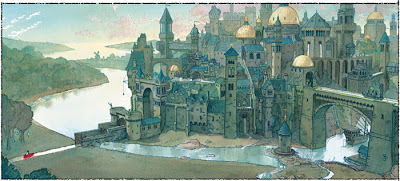 "From there, it’s a matter of old-school pen and ink and watercolor. I do the pen and ink first, making sure to give myself the freedom to change anything from the pencil underlay should the spirit move me. That said, I find the more I’ve decided conceptually ahead of time, the more I can concentrate on pure technique at any stage of the image-making game."

"Watercolor is applied in several washes from light to dark and then finished up with shadow details. I try to minimize the use of any masking fluid as I find this changes the quality of the paper for subsequent washes. Gouache was used for all of the punchy red and purple bits throughout the story."
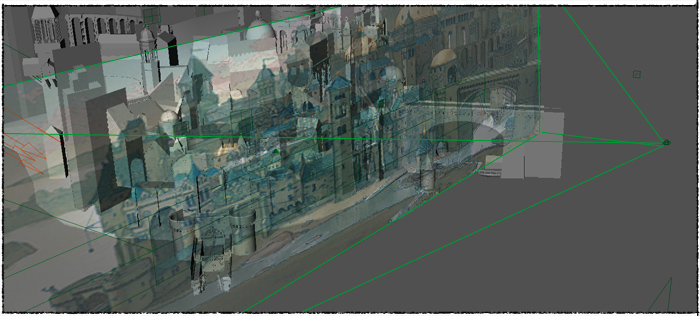
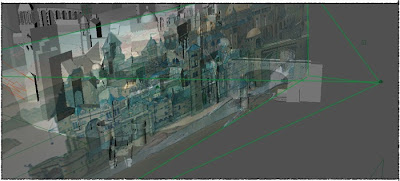 "When it came time to create the book’s video trailer (see below), I went back into the 3D model and camera-mapped the watercolor painting onto the geometry, like a virtual slide projector covering a foam-core model. After separating the painting into several layers (background, towers, castle walls, etc) I was able to move a virtual camera in Maya and bring the image to life."

"Some details, like the waving flags were hand animated and projected onto transparent “cards” in Maya. This entire technique is similar to how matte paintings are now done in feature films. Having come from a film background, I wanted to utilize as much of the tricks I had learned as possible, while retaining the hand-made feel of the watercolor paintings. In the end, there are no shortcuts when it comes to dipping a brush into pigment and placing it on the page. Hope you all enjoy the finished product!"
JOURNEY by Aaron Becker (official trailer) from Aaron Becker on Vimeo.
Here's the book trailer Aaron created.

JOURNEY by Aaron Becker (official trailer) from Aaron Becker on Vimeo.
Here's the book trailer Aaron created.
Find out more about Aaron Becker's work at http://www.storybreathing.com or on facebook.
Be sure to read the comments on this post, which explain a variety of inexpensive software options, such as Sketchup and Blender.
-----
Be sure to read the comments on this post, which explain a variety of inexpensive software options, such as Sketchup and Blender.
-----
You can pick up the book online at:
Amazon: Journey by Aaron Becker
or Barnes and Noble
Or you can order a signed copy from Aaron's local independent bookseller, Odyssey Books.
Thanks, Aaron!
Or you can order a signed copy from Aaron's local independent bookseller, Odyssey Books.
Thanks, Aaron!
Tuesday, August 27, 2013
Washington Square Arch

Here's a watercolor painting I did last Saturday of the famous Washington Square Arch in New York City. It took about an hour and it's about 5x8 inches.

Here's the setup. The blue wedge was something I made for the OPEN webcast later that day. I worked at sight-size and did some careful measuring at the beginning.
When measuring I find it helps to squint through one eye and to hold the pencil on the same plane as the drawing, so that the measurements in the scene can directly translate to the drawing.
I realize this isn't a very complete explanation of measuring for those who aren't familiar with the practice, but if you like, perhaps I can have a go at that topic in a future post.
-----
Attention Lionfish Shampoo fans: The Flickr gallery of all entries is now live at the end of the following post.
Previously: Go Vertical
