Cars For Sale - Used Cars For Sale - Used Cars - Sellcar-online.com®: Art Schools

Cars For Sale - Used Cars For Sale - Used Cars - Sellcar-online.com®

Used Cars - New Cars - Search New & Used Cars For Sale

Showing posts with label Art Schools. Show all posts

Tuesday, November 19, 2013

Dinosaur illustration assignment at MICA

November 19, 2013 0
Daniel Iturralde painting a dinosaur in Patrick O'Brien's class at MICA
Patrick O'Brien, who teaches illustration at the Maryland Institute of Art (MICA), came up with an assignment for his digital and oil-painting students. The goal was to paint a dinosaur in a convincing environment using the process outlined in my books and videos.

The classes began by watching my DVD "How I Paint Dinosaurs" and reading my books Color and Light and Imaginative Realism.

Patrick brought in some of his own dinosaur maquettes, and the students sketched them from various angles as they developed compositional ideas in thumbnail form.


Once they decided on their compositions, they photographed the maquettes and gathered images of background environments.


Then they drew comprehensive layouts of their compositions based on their references, before going to finish. Both Patrick's oil-painting students and his digital students followed the same basic process.

Julianne Ostrander portrayed her Stegosaurus on a high ridge with a dramatic view down to a lake. She captured the reflected light of the sun bouncing off the near dorsal plates to the far plates.

Niki Sauter created this digital image of a dinosaur prowling through a moody atmospheric landscape. Kudos to all the students, and thanks to Patrick for working with my books and vids!

If you're an art teacher, and you want to use my books or videos in your class, please send me some photos and I'll try to feature them on the blog. Also if you order a classroom set of my books, I can do dino drawings in them and personalize them with the student's names.
-------
More about Patrick O'Brien
Previously: Painting demo at MICA
Read More

Tuesday, September 10, 2013

Do artists need to learn non-computer skills?

September 10, 2013 0
D. Peters asked: "Ok, random question. A bunch of art teachers are debating whether or not learning how to use a ruler and how to draw things to scale is still a needed skill for today's artists. Some argue that with technology, we no longer have the need to learn how to scale up or down by hand. Others say that even with the technology, there is still a need for artists to learn how to draw and shape to scale by hand. Opinion?"
Jeanette in my basement studio, which I occupied 1985-1991
My answer: I feel nearly all practical skills are worth learning, even if a computer can do them more efficiently. The more skills you master, the stronger you are as a person and as an artist. Consider, by way of example, the skill of mental arithmetic. If you can accurately add a column of numbers in your head, you will use the skill all the time, even though that function is readily mechanized by calculators.

I suppose teachers of art rightly worry about which skills are more worth teaching than others, given the limited time they have to prepare a group of graduates for the real demands of a job marketplace. Most art teachers I've asked about this question have told me that both traditional skills (such as perspective) and computer skills (such as Google Sketchup) are worth learning, but the problem is the limited class time available to teach it all. Many digital animation studios want animators who have some training in hand-drawn or stop motion animation because it gives their digital work more grounding.

The path of learning is different when you are teaching yourself. You will teach yourself whatever skills you need to match the demands of a given project. Project-based self-teaching is fueled entirely by your personal obsessions. It may lead you to a rare mastery of a forgotten art, such as ornamental glass art. 

In this new Internet economy, the people who succeed are those who—lured by the happy demons of curiosity—learn a suite of skills, including both digital and traditional skills, that makes them different from anyone else, and thus indispensable to society. And because we're human, we might wish to learn skills that have no immediate practical value whatsoever, such as juggling, piano playing, wood engraving, or knitting. 

Such learning, I believe, is at the core of Adam Savage's Ten Rules for Success.
Read More

Sunday, February 24, 2013

WPI Game Development

February 24, 2013 0
On Thursday I visited the Worcester Polytechnic Institute (WPI) in Massachusetts as a guest of the department of Interactive Media and Game Development (IMGD), where I gave a  lecture on Worldbuilding.

The IMGD program at WPI is designed to provide students with both programming expertise and art knowledge so that they're well rounded in their approach to interactive design.

One of the professors is Britt Snyder (left, with a Jordu Schell sculpt between us). Britt has worked as an artist in the field of video game development for the past 13 years, with clients like SONY, Blizzard, Liquid Entertainment, Rockstar, THQ, and many others.
He teaches 3D modeling, digital painting, and concept art.

WPI was one of the first to develop a program in game design, and is one of the top-ranked academic programs in the field. Since the department is part of a larger engineering school, there's always a focus on blending art and technology, with an eye on fostering close working relationships between artists and programmers.

Students get to jump right in and participate in hands-on projects and collaborations, creating games, virtual environments, interactive fiction, art installations, collaborative performances. They are encouraged to invent entirely new forms of media.

I was thrilled to be invited by PhD candidate Jia Wang to try out the virtual reality mo-cap lab, dubbed "Phase Space."

I am wearing a stereoscopic head-mounted display and holding a tracking constellation (basically a souped up Wii controller with very precise tracking points). 

The myriad sensors mounted on the outer frame follow  the exact 3D movements of my head and hand-held wand, turning me into a St. George with a sword facing off against a dragon, or whatever. 

Small fans mounted on the outer frame can generate the effect of wind, so that the player can feel completely immersed in a virtual environment.
------

Read More

Friday, February 22, 2013

New Hampshire Institute of Art

February 22, 2013 0
On Wednesday I visited New Hampshire Institute of Art for a demo and lecture. The school occupies 12 historic buildings in downtown Manchester, New Hampshire. 

NHIA offers BFA programs in Ceramics, Painting, Photography, Interdisciplinary Arts, Arts Education, Graphic Design, and Illustration. 

There are 170 illustration majors out of a student body of 540. The Illustration faculty includes (from left to right) Ryan O'Rourke, Leigh Guldig, Jerry LoFaro, Kristina Carroll, me, Natalya Zahn, Jim Burke, and Doug Sirois. Follow the links to see their work on their personal websites. 


Kristina Carroll teaches courses on Science Fiction/ Fantasy and Worldbuilding. Above are some samples of student work. Kristina says: "Good technique is the foundation of all illustration, and concept is the heart of it. Regardless of style or subject matter, by learning the tried and true methods of the old masters and developing a strong process, students will acquire the tools to develop share their ideas clearly."

Speaking of tools, one student named Daniel showed me the sketching box he improvised. He hot-glued watercolor half pans onto the inside of the lid at far right, and mixed the paint on the inside surface. Smart idea! Who needs to buy those expensive watercolor sets?

NHIA is also hosting a small show of 25 original Dinotopia artworks, including "Dinosaur Parade" (above, frame by Troy Stafford), "Garden of Hope," "Dinosaur Boulevard," "Small Wonder," "Up High," and "Waterfall City." There are also a few preliminary sketches and reference maquettes. The show, organized by the Norman Rockwell Museum, contains a completely different set of artwork from the recent show in Connecticut. The NHIA museum is located at 77 Amherst Street and will be up through March 13.

Lines and Colors announcement of the show, with closeups of Dinosaur Parade
Read More

Saturday, January 12, 2013

Gamut Mapping at MICA

January 12, 2013 0
Many painting teachers have been using Color and Light: A Guide for the Realist Painter as a textbook in the classroom. Patrick O'Brien, who teaches painting at the Maryland Institute College of Art, described the lesson he taught out of the book:

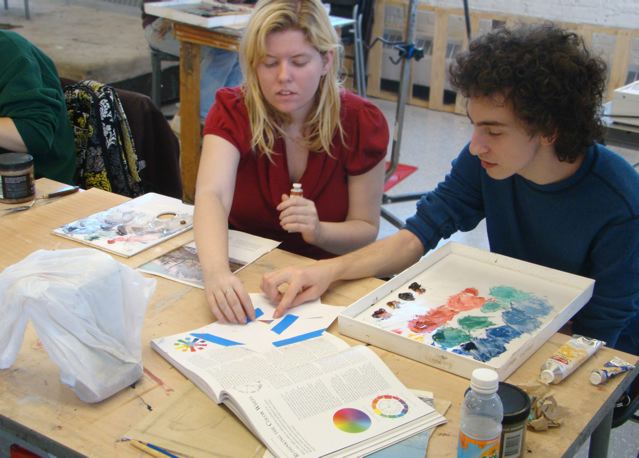
We experimented with your method of gamut masking and mixing color strings. We used pages 123-131 in Color and Light, and also referenced pages 106-107 and 116-117.
For the exercise I brought in some simple photographs for them to copy, because I wanted to take the drawing element out of it, so they could concentrate on the color scheme. On the morning of class I went to the MICA library to find a color wheel to use. 
 In flipping through all the books about color, I could not find a single good color wheel that went to grey in the center. So we had to use the small color wheel in your book on page 75. We used index cards and tape to make the masks. As you can see, some students' first instinct was to photograph it with their phone and bring it back to their seat.  
 I had each student draw the subject twice. We did one small painting in one color gamut, and then their homework is to do another painting of the same scene in the other gamut. Pretty much exactly what you did in your video with the CircusCircus sign. 
 And now I've been inspired to incorporate these ideas into my own painting as well. I'm working on a New York 1940s maritime scene that would be perfect for a cool gamut.
Thanks for the great ideas! ---Patrick O'Brien, MICA

If other instructors are doing class projects based on ideas in Color and Light, please send me photos and a description, and I’ll try to share them on the blog.

And if you want to use Color and Light as your course guide, please let me know. At our little web store, we can offer you discounts on group orders, and I can sign them for each of your students.

MORE INFO:
Color and Light: A Guide for the Realist Painter signed from my web store
Color and Light: A Guide for the Realist Painter on Amazon
All photos by Patrick O'Brien
Previously on GJ:
My painting demo for Patrick's class at MICA 
Jason Dowd's use of C&L at LCAD


Read More