Cars For Sale - Used Cars For Sale - Used Cars - Sellcar-online.com®: Lighting

Cars For Sale - Used Cars For Sale - Used Cars - Sellcar-online.com®

Used Cars - New Cars - Search New & Used Cars For Sale

Showing posts with label Lighting. Show all posts

Saturday, September 14, 2013

Hard and Soft Light

September 14, 2013 0


What is meant by hard and soft light?

Hardness or softness refers to how large the primary light source appears to be from the point of view of the subject. A hard light comes from a small, sharp source. Even though the sun itself is a very large object, it’s a relatively hard source of light because the disc of the sun appears small in the sky. A streetlight or a theater spotlight is also a hard source. Think of a hard light source as one that you could completely cover up with your thumb held at arm’s length. A medium-hard light is one that you could cover up with the width of your palm.

Soft light, on the other hand, shines out from a wide area, as seen from the subject’s point of view. This could be a fluorescent light, a north-facing window, or an overcast sky. A soft source is any light that appears larger than a piece of office paper held at arm’s length.

A plaster écorché in hard light (left) and soft light (right) 
Effects of hard and soft light
Any given light source becomes harder as it moves farther back from the subject and gets progressively smaller from the subject’s perspective.

These two photos of an écorché head demonstrate the effects of hard and soft light outdoors at midday. At left, direct sunlight coming from above and to the right illuminates the head. Note the clear division between light and shadow, the crisp edge of the cast shadow projected by the nose onto the chest, and the pocket of shadow in the eye socket.

At right, the same head is lit by a soft light positioned directly above. With the direct sunlight diffused, there’s no clear division of light and shadow, and no definite edge to the cast shadows. Instead, the darkest tones appear in the hollows and the down-facing planes.
Soft light: "Waiting at the Window" from Dinotopia: Journey to Chandara by James Gurney
In soft light, planes tend to get lighter as they face upward since they receive more and more of the diffused light from above. In the case of this photo, the light is diffused by a large white piece of fabric, but it would be the same effect if the sky were covered with a thin layer of clouds.

Hard light: 15 minute figure study in oil by James Gurney
Hard light is more directional and dramatic, but it can also be harsh and unflattering. Highlights are more pronounced. It casts crisper shadows and it brings out more surface texture, especially in the region of the half light, where light turns to shadow.

Soft light is generally more suited to portraiture because it shows fewer wrinkles. Because there are no sharp-edged cast shadows, the overall effect is simpler. Tonal transitions from light to shade are more gradual in soft light compared to hard light. 
-------
For the complete article, with additional illustrations and more info, including how to set up your lights to get hard and soft light, pick up a copy of the current issue of International Artist magazine, voted the #1 art magazine by GurneyJourney readers. The issue also has an article by Mitchell Albala on notan and a call for entries for a contest about seascapes, rivers, and lakes.

For more on light, you can get my book Color and Light: A Guide for the Realist Painter signed from me or from Amazon.

Read More

Thursday, March 28, 2013

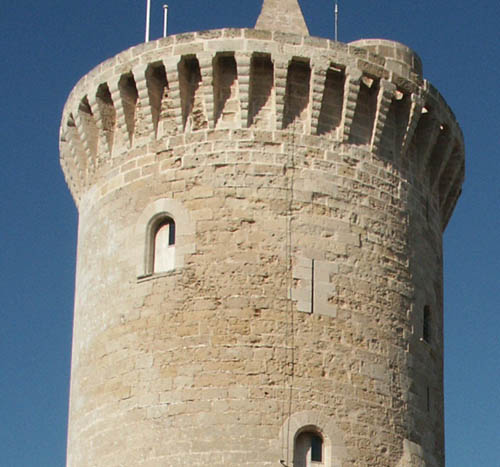
Texture in a sunlit round tower

March 28, 2013 0
This drawing of a round stone tower illustrates a basic principle of light on form: in direct sunlight the appearance of greatest texture occurs at the area of the form called the darker halftone, just before the line of the terminator divides light from shadow. 

In this case, the region is three quarters of the way to the right of the tower since it's lit from above and to the left. The rough texture of the stone is not very apparent within the big open shadow areas and in the areas on the left of the tower where it is directly front-lit. 

The drawing is in graphite pencil and gray wash, about 6x7 inches. As with any sketchbook drawing, I had to be selective about where to put my time and effort. So with the limited time I had, I loaded the shadow edge with fine detail and summarized the other areas with flat tones.


(photo of Castle Bellver by Randy B.)
A common mistake in rendering a textural form in sunlight is to make the texture equally prominent throughout the form. In digital images, the appearance of overall equal texture can result from mapping a bumpy two-dimensional pattern equally over a 3D form. The texture in the shadow should not just be a darker version of the texture in the light because that’s not how the eye sees it. 

The reason the texture is difficult to see in the shadow region is because it is lit from a variety of directional sources, including the blue sky above and reflected sources from below. These multiple sources effectively cancel the appearance of texture.
-----
Read More

Saturday, March 16, 2013

Highlights and Specularity, Part 1

March 16, 2013 0
This photograph shows three spheres with varying surfaces. The one on the left is matte, the one in the middle is glossy, and the one on the right is highly reflective. 


On the matte sphere there is no highlight. On the glossy sphere in the middle, the highlight is clearly apparent. The mirror-like sphere on the right also has a highlight, which is really a reflection of the light source. The light source is the sun shining through a window.

The right sphere also reflects the scene around the ball, including the white paper background and the dark room behind the camera. In the right ball, you can even see a reflection of the middle ball, with a highlight in the middle of that reflection.

That same pattern of reflections of the paper, room, and neighboring ball is subtly visible in the middle ball as well.

In the middle ball, there is a second, smaller highlight just to the right of the primary highlight. This secondary highlight is the sunlight is reflected three times. The light bounces off the middle ball, bounces back off the right ball, and bounces again off that little highlight on middle ball back to your eye.

So we've arrived at a definition: A highlight is a specular reflection (Latin "speculum"=mirror) of the light source on a shiny surface. The shinier and smoother the surface, the brighter and clearer the highlight.

These three diagrams show what's happening at the surface level. On the matte surface, light arrives from the top left and hits the rough surface. Some light gets absorbed and the rest scatters away in all directions. This is what happens when light hits a matte surface like a sand dune or a sweater.

The glossy surface of the middle ball bounces a a portion of the light at the same relative angle as the incoming light, but some of the light rays hit uneven spots and bounce in random directions. This is like bouncing a golf ball on a country road. It will probably bounce the way you want it to unless the golf ball hits a crack or a pebble.

The mirror-like surface is so smooth that all the light bounces off the surface predictably at the same relative angle, like bouncing a ball off a basketball court. (Edit: a true mirror-like reflection requires a metallic surface, and cannot be achieved by smoothness alone. Thanks, David!)


Since highlights belong to the world of specular reflection, they should be thought of as somewhat separate and distinct from the normal modeling factors (light, halftone, and shadow) of diffuse reflection. Artists in the world of 3D computer graphics can control the form-modeling and the specularity as separate components.

I wrote an article on this subject of "highlights and specularity" for the current issue of International Artist magazine, which should be on the newsstands now. This blog post is just a little piece of it.


The six-page article contains a lot more examples and explanation, and it includes artwork that has never been reproduced in print before. I'll talk more on the blog about highlights in real-world examples tomorrow.
----
International Artist magazine, Issue 90
This subject is also covered in my book Color and Light: A Guide for the Realist Painter (Amazon), also available signed from my website store.

Read More