Cars For Sale - Used Cars For Sale - Used Cars - Sellcar-online.com®: Book reviews

Cars For Sale - Used Cars For Sale - Used Cars - Sellcar-online.com®

Used Cars - New Cars - Search New & Used Cars For Sale

Showing posts with label Book reviews. Show all posts

Sunday, February 2, 2014

Book Review: Painting on Location

February 02, 2014 0
David Curtis is one of the leading plein-air painters, working in both watercolor and oil in the United Kingdom. He tackles complex scenes with admirable fluency and accuracy, and is one of the contemporary masters of contre-jour lighting.

For both dedicated fans and people new to his work, his newest book, Painting on Location: Secrets to Plein Air Painting, is an excellent presentation of his working methods, with many large reproductions of paintings that don't appear in previous books on Curtis's work.

His subject matter includes primarily coastal views, city scenes, and rural landscapes—no portraits or still lifes.


Curtis typically works fairly small in oil. Most of his paintings are around 8x10 or up to 12x16 inches. In his book he discusses how speed and confidence are affected by the scale of the work, and by other challenges such as limited time and changing light.

The book gives equal weight to his watercolors, which makes it valuable to specialists in either oil or watercolor, or to artists who want to branch out to a new medium. There are a few step-by-step sequences, photos taken of the motif for comparison, and photos of the painting rig.

Here's a video shot on location that shows some of the watercolor techniques in action. Curtis confidently drops color into wet washes in the early "ghost wash" stage. As he says, "Observe once, observe twice, and dive in."

(Video link) And here's another video trailer showing his oil techniques.

...also available from the North Light bookstore

Read More

Tuesday, January 7, 2014

Book Review: "Jim Henson: The Biography"

January 07, 2014 0
I just finished reading Jim Henson: The Biography. The book tells the story of Henson's lasting influence as creator and performer of the Muppets.

Biographer Brian Jay Jones interviewed the Henson family and his creative colleagues, and carefully went through the archives to create a very carefully researched and readable account of his short life (he died in 1990 of a lung infection at age 53.) Henson's kind, generous, restless, and inventive spirit, as well as some of his human foibles, come shining through the book.

Now with so many of Henson's shows available on YouTube, you can enhance the experience of reading the book by watching videos of everything from his hilarious early TV commercials for Wilkins Coffee, the gig with Rowlf on the Jimmy Dean Show, his documentary on the art and history of puppetry, the Muppet Show pitch, and clips of the big-screen Muppet movies and the '80s fantasy films "Dark Crystal" and "Labryrinth."

Book on Amazon: Jim Henson: The Biography
Wikipedia about Jim Henson (1936-1990)
Thanks to blog reader ROTM for recommending it.


Read More

Friday, December 13, 2013

Book Review: Anders Zorn: Sweden's Master Painter

December 13, 2013 0

The new book Anders Zorn: Sweden's Master Painter is a career survey catalog published to accompany the exhibition that's now in San Francisco.


I hesitated to buy it (upper left) because I already have other Zorn books, but I'm glad I did. It's got faithful reproductions, well-written essays, and quite a few images that haven't been published before.


The text is by four authors, all Zorn experts, including a biographical essay by Johan Cederlund, director of the Zorn Collections in Zorn's hometown of Mora, Sweden. They discuss his experiences in America, his nudes, his portraits, and his place in Swedish culture. There's not much coverage of his technical methods or specific insights from an artist's point of view, unfortunately.


I was glad to see many of Zorn's watercolors included. Zorn painted exclusively in watercolor early in his career, and switched mostly to oil later on. Zorn picked the most difficult subjects for his watercolors, such as boatmen in open water, or portraits of children from life.


In Zorn's etchings, figures emerge from an atmosphere of slashing parallel strokes. The etchings were my first introduction to his work when I saw an exhibition of them back in about 1977. The etchings are well represented both in the exhibition and the catalog, with a chapter by James Ganz "Etching in the City of Light: Anders Zorn Among the Post-Impressionists."

The book is hardbound, 9x12 inches, 224 pages, with many large reproductions, something many art book publishers neglect to offer.
------
RESOURCES:
Book: Anders Zorn: Sweden's Master Painter
Exhibition: at the Legion of Honor Museum in San Francisco until Feb 2, and will then travel to the National Academy in New York, opening at the end of February, 2014.
Read More

Tuesday, November 26, 2013

Book Review: How to Draw, by Scott Robertson

November 26, 2013 0
Until now, I had to rack my brain to think of what instructional book to recommend for a student who wants to learn perspective.

No longer. Scott Robertson's new book, "How to Draw: drawing and sketching objects and environments from your imagination" lays out all the principles and practices of drawing objects in perspective from your imagination.

The emphasis is on how to draw things in perspective with traditional tools, but the principles apply to digital artists, too. The book begins with basic drawing materials and techniques, and then defines underlying concepts like cone of vision, viewing position, horizon line, and vanishing points, concepts that are often skipped over in other books. The book then goes on to explain exactly how to draw a form with compound curves—such as a car or an airplane—either from observation or imagination.

The book, by Robertson's own publishing company Design Studio Press, is large (9x11 inches), thick (208 pages), and printed on good paper. The book also has innovative video content of the book that can be sourced by a URL inside and on an Android app that is still waiting on iOS approval.

Scott is both a master teacher and a concept artist who has designed vehicles for many feature films. He has been working on this book for most of his professional career, and it benefits greatly from his experience as artist, teacher, and publisher.
------
How to Draw: drawing and sketching objects and environments from your imagination
Other book recommendations in my "Survival Guide for Art Students"

Read More

Wednesday, July 31, 2013

Book Review: The Art of the Salon

July 31, 2013 0

A recently published book called the The Art of the Salon: The Triumph of 19th-Century Painting is a lavish and visually impressive production which fills a long-neglected gap on the art history bookshelf. 

The book is a very large slipcased hardcover featuring the painting The Roses of Heliogabalus (above) by Lawrence Alma Tadema on the cover. The book is 288 pages and measures 14 x 12 inches, weighing in at more than 7.5 pounds, making it the ultimate coffee table book. It's so big it will hardly fit on a regular bookshelf.


The scope of the book is ambitious, too. It not only includes the French Salon tradition, but also samples of Victorian painting, works from the American Hudson River School, and some pieces from Eastern Europe.

The introduction discusses the causes of the recent revival of interest in Salon painting and compares the spectacle of many 19th century epic history paintings to the popular appetite for extravagant Hollywood movies.

Carl Theodor von Piloty - Seni at the Dead Body of Wallenstein
The 230 color reproductions include masterpieces not only by acknowledged masters such as Bouguereau, Gerome, Waterhouse, Leighton, but also by many other deserving but lesser-known painters, such as Morelli, Cormon, and Makart. The size of the reproductions ranges from generous double page spreads to small images the size of postcards or even business cards, but on balance, compared to many other recent books, the pictures are ample in scale. There's so much more detail in a good printed reproduction than most internet images.

The book examines Paris as a cultural capital, the business of the Salon exhibitions, and the spread of academic training around the world. Most of the second half of the book is organized thematically, with subjects such as national history, the "West-Eastern Divan," and "Between Sensuality and Prudery."

Unfortunately, the writing style is difficult to understand. This may have been partly the consequence of the translation from the original German. For example, here's a sample sentence, pulled out at random: "The description of the everyday, indeed of the trivial, and not seldom also the grotesque and satirical, the ugly and the lowly does not tolerate stylization (for example an antiquizing body position, dramatic gestures, selected accessories as expressions of dignity) or formal and compositional idealizing (for example a classical, friezelike arrangement of figures, a hierarchical frontality and so on)." 

Compared to more readable and informative accounts of salon painting by people like Barbara Weinberg the book misses an opportunity to lay out the simple facts and stories about Salon painting in straightforward language. Nevertheless, the book is a welcome addition to the library of any fan of academic painting, and browsing it is a rich visual feast.
----
Two other excellent books on the subject:
Barbara Weinberg: The Lure of Paris: Nineteenth-Century American Painters and Their French Teachers
Read More

Wednesday, July 17, 2013

Book Review: Pterosaurs by Mark Witton

July 17, 2013 0
Pterosaurs dominated the skies during the time of the dinosaurs. They were remarkably diverse creatures, from the size of a sparrow to giants as tall as a giraffe, and were by far the largest creatures ever to fly.

One of the tallest subgroups, known as the azhdarchids, stood as tall as giraffes.

Yet surprisingly, the scientific story of pterosaur anatomy, ecology, and extinction has not been told as thoroughly as has that of the dinosaurs.

A new book called Pterosaurs: Natural History, Evolution, Anatomy helps to fill the gap. It is published by Princeton University Press, the same publisher that produced The Unfeathered Bird by Katrina van Grouw.

Mr. Witton is the ideal person to write such a book. He combines his deep knowledge of the subject as a paleontologist at the University of Portsmouth (U.K.) with his skills as an artist, and he has a flair for informal but accurate writing. His 292-page book is the most comprehensive and authoritative book to come along since Peter Wellnhofer's classic Illustrated Encyclopedia of Pterosaurs back in 1991.


The book contains about 200 illustrations, mostly in color. Typically Witton portrays each type in a side-view flying position at the bottom of the flap cylce. In most cases the color restoration is accompanied by a line drawing of the reconstructed skeleton in the same pose. There are also many fossil photographs, maps, diagrams, and full-environment restorations.

Witton's book covers general topics first, such as what we know and don't know about the skeletons, soft tissues, coloration, aerodynamics and behaviors. He then covers more than 130 species group by group, including many recently discovered and beautifully preserved specimens. The back of the book has a very thorough list of references and an index for deeper reading.
----
Find out more:
Amazon: Mark Witton's new book Pterosaurs: Natural History, Evolution, Anatomy
Amazon: Peter Wellnhofer's 1991 book Illustrated Encyclopedia of Pterosaurs
Facebook page for the book
Princeton University Press webpage
.
Read More

Friday, June 7, 2013

Book review: Martín Rico exhibition catalog

June 07, 2013 0

During the flowering of plein-air painting in the late 19th and early 20th century, some of the most impressive artists came from Spain.


Joaquín Sorolla is perhaps the best known in the USA, but there were other brilliant painters who deserve to be better known, such as by Raimundo and Ricardo de MadrazoMariano Fortuny, and Martín Rico (1833-1908).


A big exhibition of Martin Rico's landscapes is currently on exhibit at the Meadows Museum in Dallas, Texas. With the help of the Prado museum, they have produced an excellent catalog, which fills a huge gap in scholarship on the artist.

The large softcover catalog measures 9.5 x 11 inches and weighs almost four pounds. It includes 243 well-reproduced images, mostly his paintings in color, along with some period photos and many pages from his pencil sketchbooks. 

The text is well researched and includes an extensive biography organized by the artist’s granddaughter, Madame Claude Rico Robert. The book traces Rico's beginnings as a watercolorist, his time with the landscape painters Alexandre Calame (Switzerland) and Charles-François Daubigny (France), and his productive years in Andalucía and Venice.

In the back of the book is a record of sales, some of Rico's letters translated into English, and a bibliography. 
Read More

Wednesday, May 22, 2013

New book on memory drawing

May 22, 2013 0
Much of the training in contemporary academic ateliers focuses on understanding and interpreting what you see in front of you. At the moment, there's a growing interest in supplementing those skills with the training of memory and imagination.


To fill that gap, academic painting instructor and painter Darren Rousar has written a much-needed new book called Memory Drawing: Perceptual Training and Recall.

On his website MemoryDrawing.com, Rousar says: "All drawing and painting from life is at some point done from memory, even if that memory is only seconds old. An artist’s ability to recall something previously seen is all the more important when their subject is no longer in view. Da Vinci, Corot, Degas, Whistler, and Inness wrote about it. In fact, Inness claimed that many of his best landscape paintings were done from memory."

Mr. Rousar's book approaches the subject from a variety of angles, starting with the history of how it has been taught in the past, including the notable contributions of Horace Lecoq de Boisbaudran. The focus then turns to the science of memory and perception. Then the book analyzes the process involved in seeing and remembering.

The slim and inexpensive 140-page softcover book includes many black and white illustrations with specific exercises involving line, shape, and value. The book ends with valuable appendices by Père Lecoq and Harold Speed, and a glossary. The book is thoughtfully and clearly written, and will benefit both teachers and students interested in improving their powers of memory.
----
Resources
Book: Memory Drawing: Perceptual Training and Recall by Darren Rousar
Free digital book of the French classic "The Training of Memory in Art and the Education of the Artist" by Père Lecoq
Website: Memory Drawing
Previously on GurneyJourney:
Memory Game with Maps
Drawing from Memory
Remembering a Face

Read More

Thursday, May 2, 2013

Sargent Watercolor Catalog

May 02, 2013 0
The new book on John Singer Sargent's watercolors accompanies the exhibition that is currently at the Brooklyn Museum through July 28. 

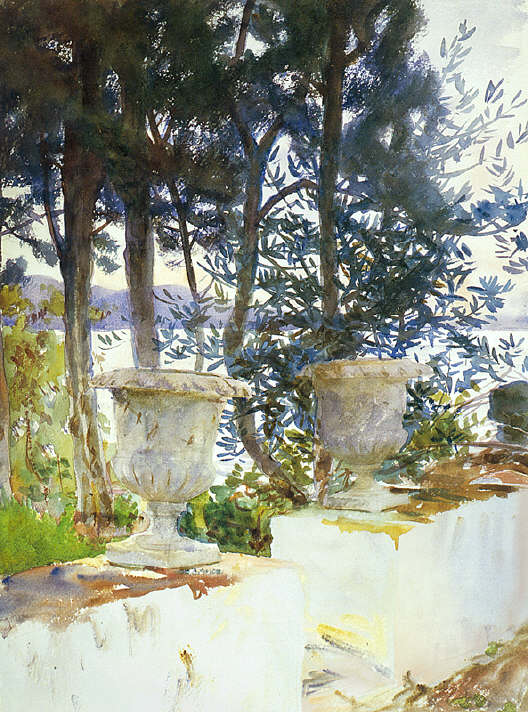
The show unites the extensive collections owned by the Brooklyn Museum and the Museum of Fine Arts in Boston, comprising nearly 100 of Sargent's best watercolors of Venice, Bedouins, alpine quarries, villa gardens, and informal portraits. 

The two institutions pooled their considerable expertise to make an art book that sets a standard for what is possible with a show catalog. The book is large: 10 x 12 inches (25 x 30cm) and an inch thick at 248 pages. There are 175 color illustrations, mostly reproduced full page, with many full bleeds and close-up details and many works that haven't been seen before.

For all Sargent's success and proficiency as a portrait painter, he regarded the official oil portrait work as his "gagne-pain ('bread job'), which I am delighted to get rid of." His watercolors were what he did to experiment. They show a breathtaking boldness of perspective, color, and brushwork.

The text of the catalog is written by leading Sargent scholars, such as Richard Ormond, together with Erica Hirschler and Teresa Carbone, curators at Boston's MFA and the Brooklyn Museum respectively. 

Ormond points out that Sargent was eager to exhibit his watercolors to build new awareness for his range as an artist, but he was very reluctant to sell them, and only agreed to do so when they could be sold as a unified group to the museums.


Artists will find the final chapter by Annette Manick and Antoinette Owen especially fascinating. They have scientifically analyzed the paintings, sampled the paint, photographed the art up close and under raking light, and scrutinized it under infrared reflectography (IRR). 

Sargent used every trick in the book in his watercolors: glazing, wax resist, gouache, impasto, lifting off, scraping, drybrush, and ox gall. As he worked, he muttered "Demons, demons," and he famously described painting in watercolor as "making the most of an emergency."

This analysis reveals that some of the architectural paintings have very careful perspective drawings as their foundation, despite the loose washes that meet the eye.

Other paintings, like this portrait of a tramp, show no evidence of an initial pencil drawing, which means Sargent made his first touches with a brush. The portrait has tremendous presence and a sense of the vivid encounter.

Even if you already have a lot of books on Sargent, this is a must-have catalog, highly recommended.

Book: John Singer Sargent: Watercolors
The show is currently at the Brooklyn museum through July 28, then goes to Boston's Museum of Fine Arts October 13, 2013 - January 20, 2014.
Read More